Debt Snowball vs Debt Avalanche
Paying off multiple debts can feel overwhelming when every account has a different balance, interest rate, and minimum payment.
The good news is that you don’t have to attack everything at once.
Two popular debt payoff strategies can help you organize your payments: the debt snowball method and the debt avalanche method.
Both methods require you to keep making the minimum payments on your debts. The main difference is where you send your extra money.
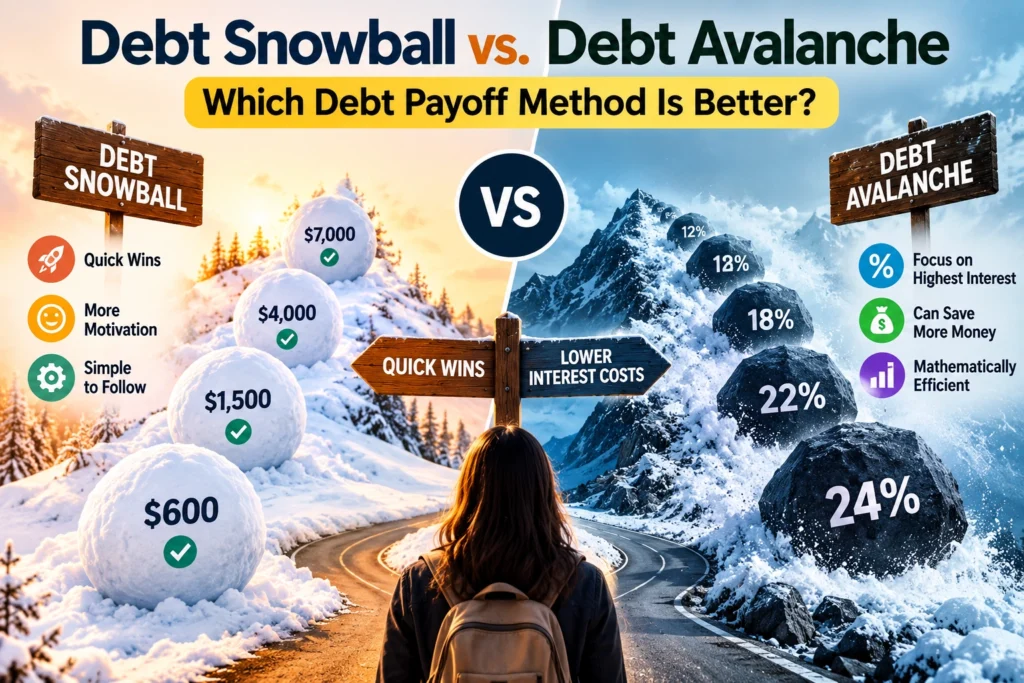
The debt snowball focuses on your smallest balance first, while the debt avalanche focuses on your highest interest rate first.
So which one is better?
It depends on what matters most to you.
If you want quick wins and motivation, the snowball may feel easier to stick with. If your priority is reducing interest and potentially paying less overall, the avalanche can be more efficient.
In this guide, I’ll explain how both methods work, compare them side by side, and help you decide which debt payoff strategy may fit your situation.
Debt Snowball vs. Debt Avalanche at a Glance
| Debt Snowball | Debt Avalanche | |
|---|---|---|
| Main focus | Smallest balance | Highest interest rate |
| Extra payment goes to | Smallest debt | Highest-interest debt |
| Minimum payments | Continue on all debts | Continue on all debts |
| Main advantage | Quick psychological wins | Can reduce interest costs |
| Main challenge | May cost more interest | Progress can feel slower |
| Best for | People motivated by quick wins | People focused on mathematical efficiency |
The biggest difference is simple:
Snowball = smallest balance first.
Avalanche = highest interest rate first.
What Is the Debt Snowball Method?
The debt snowball method is a debt repayment strategy where you pay your debts from the smallest balance to the largest, regardless of interest rate.
You continue making at least the minimum payment on every debt.
Then you put any extra money toward the smallest balance.
Once that debt is completely paid off, you take the money you were using for that payment and roll it into the next smallest debt.
That’s where the word “snowball” comes from.
Your payment toward the next debt becomes larger as you eliminate each previous balance.
How the Debt Snowball Works
Let’s say you have four debts:
| Debt | Balance | Interest Rate |
|---|---|---|
| Credit Card A | $600 | 24% |
| Credit Card B | $1,500 | 18% |
| Personal Loan | $4,000 | 12% |
| Credit Card C | $7,000 | 22% |
With the snowball method, you don’t care which debt has the highest interest rate.
You arrange them by balance:
- $600
- $1,500
- $4,000
- $7,000
You make the minimum payment on all four.
Then every extra dollar goes toward the $600 debt.
Once that balance reaches zero, you move to the $1,500 debt.
The payment you were making toward the first debt is now added to the second debt’s payment.
Then you repeat the process.
Why Do People Like the Debt Snowball?
The biggest advantage of the snowball method isn’t necessarily mathematical.
It’s psychological.
Paying off a debt completely can feel very different from simply reducing a large balance.
For example, going from:
$600 → $0
can feel more rewarding than:
$7,000 → $6,400
even though the second payment may have saved more interest.
That early win can give you motivation to keep going.
For someone who has struggled to stay consistent with debt repayment, that motivation can be valuable.
Pros of the Debt Snowball
1. You Get Quick Wins
Smaller debts can disappear faster.
That gives you visible progress.
2. The Strategy Is Simple
You don’t need to compare interest rates every time you make a payment.
Just arrange debts from smallest balance to largest.
3. It Can Improve Motivation
Removing an entire account can make the debt payoff process feel more manageable.
4. Your Monthly Cash Flow Can Improve
Once a debt is fully paid, the minimum payment associated with that account is no longer required.
You can then direct that money toward your next debt.
Cons of the Debt Snowball
The main disadvantage is that it doesn’t prioritize interest rates.
Imagine you have:
- $500 debt at 8%
- $5,000 debt at 25%
The snowball method tells you to attack the $500 balance first.
That can give you a quick win, but the $5,000 debt is costing you much more in interest.
If your goal is strictly to minimize interest, another strategy may be more efficient.
What Is the Debt Avalanche Method?
The debt avalanche method takes a different approach.
Instead of starting with your smallest balance, you start with the debt carrying the highest interest rate.
You still make the minimum payment on every debt.
But your extra money goes toward the debt with the highest APR.
Once that debt is paid off, you move to the next-highest interest rate.
You continue until all your debts are gone.
How the Debt Avalanche Works
Using the same example:
| Debt | Balance | Interest Rate |
|---|---|---|
| Credit Card A | $600 | 24% |
| Credit Card B | $1,500 | 18% |
| Personal Loan | $4,000 | 12% |
| Credit Card C | $7,000 | 22% |
The avalanche method orders them by interest rate:
- 24%
- 22%
- 18%
- 12%
So the $600 credit card at 24% comes first.
Once that’s paid off, the extra payment moves to the $7,000 card at 22%.
Then the 18% debt.
Finally, the 12% loan.
Why Does the Debt Avalanche Save Interest?
The idea behind the avalanche method is straightforward.
High-interest debt grows faster.
So putting extra money toward the highest-interest balance can reduce the amount of interest accumulating on that debt.
Over time, this can potentially reduce the total interest you pay compared with focusing on smaller balances first.
That’s the main mathematical advantage of the avalanche method.
Pros of the Debt Avalanche
1. It Prioritizes Expensive Debt
You attack the highest interest rate first.
2. It Can Reduce Total Interest
When the highest-interest balances are paid down sooner, less interest may accumulate.
3. It Can Be More Efficient Mathematically
If you’re comparing strategies based primarily on interest cost, avalanche is generally the more mathematically efficient approach.
4. It Encourages Interest Awareness
You become more aware of which debts are actually costing you the most.
Cons of the Debt Avalanche
The biggest challenge is motivation.
Your highest-interest debt may also have a large balance.
That means it could take months or even years before you completely eliminate the first account.
During that time, you might feel like you’re making progress without seeing a debt disappear.
That’s where some people struggle.
A mathematically efficient strategy only works if you can actually stick with it.
Debt Snowball vs. Debt Avalanche: A Real Example
Let’s make the difference easier to understand.
Imagine you have:
| Debt | Balance | APR |
|---|---|---|
| Store Card | $500 | 29% |
| Credit Card A | $2,000 | 24% |
| Credit Card B | $4,000 | 18% |
| Personal Loan | $8,000 | 10% |
You can afford to put an additional $500 per month toward debt after making all minimum payments.
Snowball order
You would attack:
$500 → $2,000 → $4,000 → $8,000
The first debt could potentially disappear quickly.
That gives you an immediate win.
Avalanche order
You would attack:
29% → 24% → 18% → 10%
So you would start with the $500 store card anyway because it also happens to have the highest interest rate.
But imagine the $500 card had only 5% interest.
Now the difference becomes much larger.
Snowball:
$500 at 5% → $2,000 at 24% → …
Avalanche:
$2,000 at 24% → $4,000 at 18% → …
That’s when the two strategies can produce noticeably different repayment paths.
Which Debt Payoff Method Saves More Money?
If all other factors are equal, the debt avalanche method generally has the mathematical advantage because it prioritizes the highest-interest debt first.
That means it can reduce the amount of interest that accumulates over time.
However, “saves more money” isn’t the only consideration.
Suppose someone starts the avalanche method but becomes discouraged after several months and stops making extra payments.
The theoretically more efficient method doesn’t help if it isn’t followed consistently.
That’s why the best strategy is often the one you can realistically maintain.
Which Method Pays Off Debt Faster?
This depends on what you mean by “faster.”
If you mean:
Which strategy can reduce total interest and potentially shorten the repayment period?
The avalanche can have an advantage.
If you mean:
Which strategy can help me eliminate individual debts sooner?
The snowball can create those early wins.
Your actual timeline will depend on:
- Total debt
- Interest rates
- Minimum payments
- Extra monthly payment
- New charges
- Income changes
- Fees
- Whether you stay consistent
There is no universal number of months that applies to everyone.
Which Method Is Better for Your Credit Score?
Neither method is automatically a magic credit-score strategy.
Your credit score depends on multiple aspects of your credit history.
The most important thing is to keep making required payments on time while reducing your debt.
As your balances fall, your credit utilization may also improve if you’re paying down revolving credit card debt.
If you’re working on your overall credit profile, you can read our guide on credit utilization ratio.
And if you’re looking for broader steps, see our guide on how to improve your credit score fast.
Debt Snowball vs. Debt Avalanche: Which One Is Easier?
For many people, the snowball method is easier to understand.
You simply:
- List debts from smallest to largest.
- Pay minimums on everything.
- Attack the smallest balance.
- Roll the payment into the next debt.
The avalanche requires more attention to interest rates.
You need to:
- List debts by APR.
- Pay minimums on everything.
- Attack the highest-interest debt.
- Move to the next-highest rate.
Neither is particularly complicated.
The real question is which system keeps you motivated enough to continue.
Can You Combine the Snowball and Avalanche Methods?
Yes.
You don’t have to follow either method perfectly.
For example, you might normally use the avalanche method but pay off one very small balance first because eliminating it would simplify your finances.
After that, you could switch back to the highest-interest debt.
This is sometimes called a hybrid approach.
The important thing is to have a clear reason for changing the order.
Don’t keep jumping between debts every month.
A strategy works best when you can follow it consistently.
How to Choose Between Snowball and Avalanche
Ask yourself these questions.
Choose Snowball If:
- You need quick wins to stay motivated.
- You have several small balances.
- Seeing an account reach $0 helps you stay committed.
- You prefer a very simple repayment system.
- Motivation has been your biggest problem in the past.
Choose Avalanche If:
- You are comfortable waiting longer for the first debt to disappear.
- Your highest-interest debts are expensive.
- Saving interest is your top priority.
- You are comfortable tracking APRs.
- You want a more mathematically efficient strategy.
Consider a Hybrid If:
- You want one quick psychological win.
- You also want to reduce expensive interest.
- You can create clear rules for when you’ll switch strategies.
What Should You Do Before Starting?
Before choosing a payoff method, make a complete list of your debts.
Include:
- Creditor
- Balance
- Interest rate
- Minimum payment
- Due date
Then stop and look at the entire picture.
If you’re struggling to make even the minimum payments, don’t simply choose snowball or avalanche and hope the problem disappears.
You may need a broader debt-relief strategy.
Our guide to debt relief options covers several approaches, including debt management, consolidation, settlement, and other options.
Don’t Forget to Build an Emergency Buffer
Putting every spare dollar toward debt can look great on paper.
But if you have no emergency savings at all, an unexpected expense can force you to use your credit cards again.
That can undo your progress.
Even a small emergency buffer can help reduce the chance that one unexpected bill sends you back into new debt.
The right balance between debt repayment and emergency savings depends on your income, expenses, and financial situation.
Common Debt Payoff Mistakes to Avoid
1. Paying Extra While Missing Minimum Payments
Always make the required minimum payments according to your account terms.
Extra payments should come after those obligations are covered.
2. Continuing to Add New Debt
Paying off one card while adding new balances to another can keep you stuck.
3. Ignoring Interest Rates
Even if you choose the snowball method, understand how much your debts are costing you.
4. Changing Strategies Every Month
Constantly switching priorities can make it difficult to measure progress.
5. Focusing Only on the Monthly Payment
A lower payment doesn’t necessarily mean lower total cost.
6. Forgetting About Your Budget
Debt payoff isn’t only about which account you pay first.
You also need a realistic monthly budget that makes the strategy sustainable.
A Simple Debt Payoff Plan
If you’re ready to start, here’s a straightforward process.
Step 1: List Every Debt
Write down every balance, APR, minimum payment, and due date.
Step 2: Stop Adding Unnecessary Debt
Try to avoid building new balances while you’re working through the existing ones.
Step 3: Choose Your Strategy
Pick:
Snowball: smallest balance first
or
Avalanche: highest interest first
Step 4: Pay Every Minimum
Keep all accounts current.
Step 5: Put Extra Money Toward One Target
Don’t spread your extra payment across every account unless there’s a specific reason.
Step 6: Roll Payments Forward
When one debt reaches $0, move that payment to the next target.
Step 7: Track Your Progress
Update your balances regularly.
Seeing the total debt fall can help you stay committed.
Smart Takeaway: The Best Debt Method Is the One You Can Stick With
The debt snowball and debt avalanche methods are both useful ways to organize debt repayment.
The snowball focuses on behavior and motivation.
The avalanche focuses on interest and mathematical efficiency.
If you need quick wins to stay motivated, snowball may be the better fit.
If you’re disciplined and want to prioritize high-interest debt, avalanche may make more sense.
And if neither approach feels perfect, a carefully planned hybrid strategy can work too.
The most important thing isn’t finding a magical debt payoff trick.
It’s making a realistic plan, keeping your accounts current, stopping the cycle of new debt, and consistently directing extra money toward your chosen target.
Pick a method. Make a plan. Stick with it.
Final Thoughts
Getting out of debt doesn’t happen because you choose the perfect strategy.
It happens because you choose a realistic strategy and keep following it.
The debt snowball gives you quick wins by eliminating smaller balances first.
The debt avalanche focuses on high-interest debt and can reduce the amount of interest you pay.
Both approaches can work.
The right choice depends on whether you are more motivated by visible progress or mathematical efficiency.
Whatever you choose, keep your minimum payments current, avoid adding unnecessary debt, track your progress, and give the strategy enough time to work.
One paid-off account may not change your financial life overnight.
But consistently paying down debt can.
Frequently Asked Questions
The debt snowball method pays debts from the smallest balance to the largest. The debt avalanche method pays debts from the highest interest rate to the lowest.
Neither is universally better. Avalanche is generally more efficient mathematically because it prioritizes high-interest debt, while snowball can provide faster psychological wins that help some people stay motivated.
It can help you eliminate smaller balances quickly, but it may result in more interest than the avalanche method if higher-interest debts remain unpaid for longer.
It can. By targeting the highest-interest debt first, the avalanche method generally minimizes interest costs compared with paying lower-interest balances first, assuming the same payments and no new debt.
Choose based on your priorities. If motivation is your biggest challenge, the smallest debt may be a good starting point. If minimizing interest is your priority, targeting the highest rate may make more sense.
Yes. Credit cards can be included in a snowball strategy. Continue making the required minimum payments on all cards and direct extra money toward the card with the smallest balance.
Yes. List your credit cards and other debts by interest rate, then focus your extra payment on the highest-interest debt while keeping other accounts current.
Paying down credit card balances can reduce credit utilization, which may help your credit profile. However, your score depends on multiple factors, so a particular score increase isn’t guaranteed.
Yes. You can change your repayment strategy if your financial situation or priorities change. Try to make the switch intentionally rather than constantly changing targets.
Start by making the minimum payments on time and reviewing your budget. If even the minimum payments are becoming difficult, consider speaking with your creditors or a nonprofit credit counselor rather than simply allowing accounts to fall behind.
It can be easier psychologically because smaller balances may be eliminated sooner. However, your income alone doesn’t determine which strategy is best. Your debt balances, interest rates, expenses, and ability to make extra payments all matter.