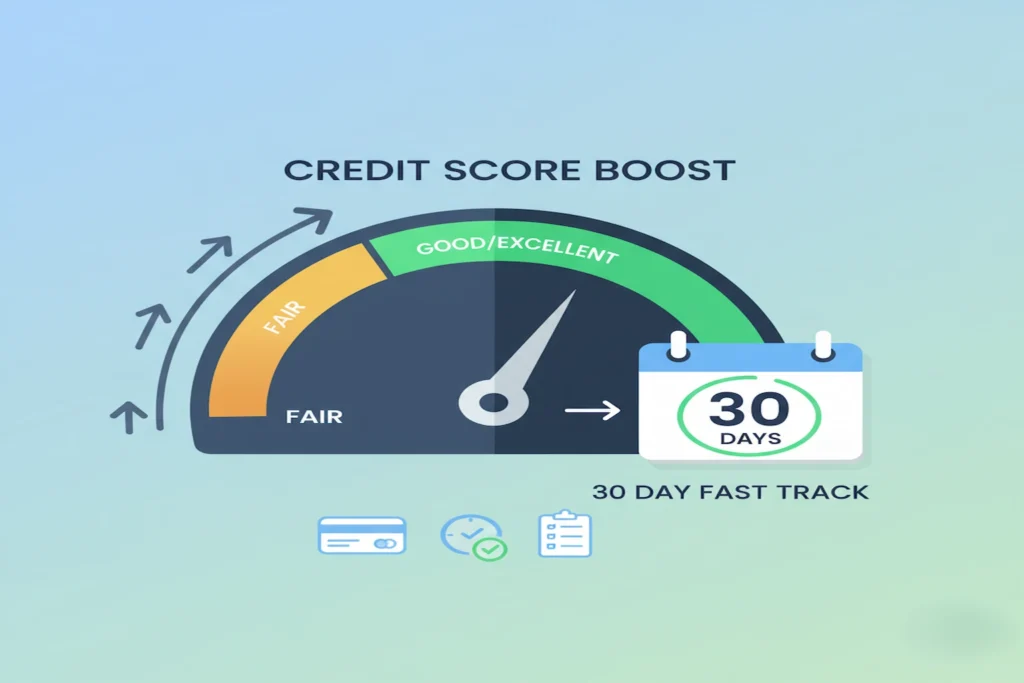
If you use credit cards regularly, your credit utilization ratio is one number you should understand.
It shows how much of your available revolving credit you are currently using. A high utilization ratio can make you look more dependent on credit, while a lower ratio generally works in your favor when credit scoring models evaluate your profile.
The good news is that utilization is one of the credit factors you can potentially change relatively quickly. Unlike the age of your credit history, you don’t necessarily have to wait years to see the effect of lowering your balances.
In this guide, I’ll explain what credit utilization means, how to calculate it, what the 30% rule really means, and practical ways to keep your utilization under control.
What Is a Credit Utilization Ratio?
Your credit utilization ratio is the percentage of your available revolving credit that you’re currently using.
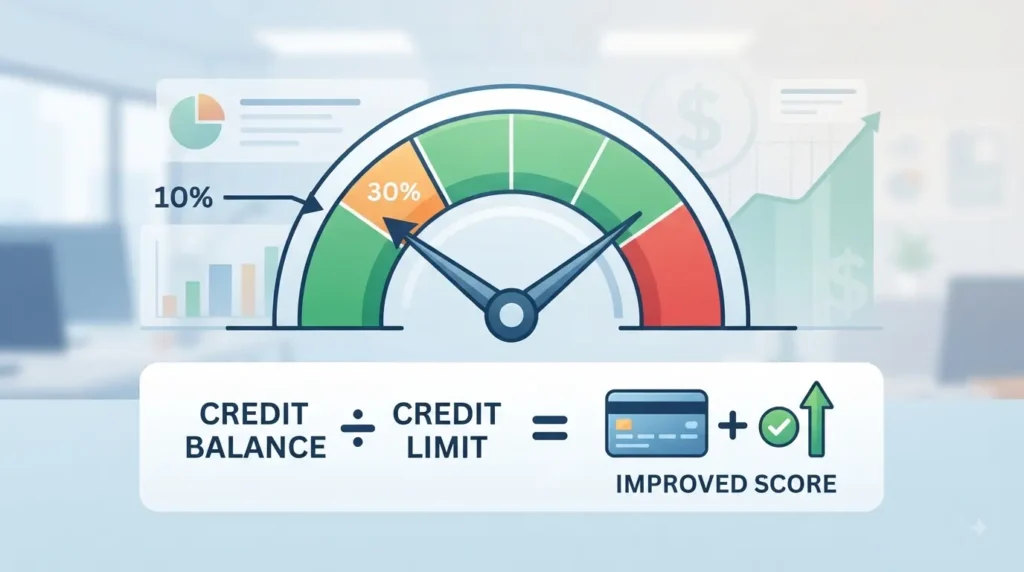
The basic formula is:
Credit Utilization = Credit Card Balance ÷ Credit Limit × 100
For example, if your credit card has a $5,000 limit and your reported balance is $1,000:
$1,000 ÷ $5,000 × 100 = 20%
Your credit utilization ratio would be 20%.
FICO explains that utilization is calculated using the balance and credit limit information reported on your credit report. Lower utilization is generally better for your score.
Why Does Credit Utilization Matter?
Credit utilization is important because it gives credit scoring models information about how much of your available revolving credit you’re using.
FICO places utilization within its broader “Amounts Owed” category, which accounts for roughly 30% of a typical FICO Score. That doesn’t mean utilization alone represents 30% of your score. The category includes other information about amounts owed as well.
Think about two people with the same $10,000 total credit limit.
Person A has a reported balance of $1,000.
Person B has a reported balance of $8,000.
Their utilization rates are:
- Person A: 10%
- Person B: 80%
The second profile is using a much larger portion of its available credit. Higher utilization can therefore be a negative signal in credit scoring.
This is one reason lowering credit card balances can sometimes produce a relatively quick score improvement compared with factors that take much longer to change.
How to Calculate Your Credit Utilization Ratio
Calculating utilization is simple once you know your credit card balance and credit limit.
Example 1: One Credit Card
Suppose you have:
- Credit limit: $4,000
- Balance: $800
Your calculation would be:
$800 ÷ $4,000 × 100 = 20%
Your utilization is 20%.
Example 2: A Higher Balance
Suppose your card has:
- Credit limit: $4,000
- Balance: $2,400
Then:
$2,400 ÷ $4,000 × 100 = 60%
Your utilization is 60%.
That is substantially higher than the first example.
Example 3: Multiple Credit Cards
You can also calculate your overall utilization across multiple cards.
Imagine you have:
| Credit Card | Credit Limit | Balance |
|---|---|---|
| Card A | $5,000 | $500 |
| Card B | $3,000 | $900 |
| Card C | $2,000 | $200 |
| Total | $10,000 | $1,600 |
Your overall utilization would be:
$1,600 ÷ $10,000 × 100 = 16%
So your overall credit utilization is 16%.
Experian notes that credit scoring can consider both overall utilization and utilization on individual revolving accounts.
Overall Utilization vs. Individual Card Utilization
This is where credit utilization gets a little more interesting.
You can have a low overall utilization rate while one individual card has a very high utilization rate.
For example:
- Card A: $9,000 limit / $500 balance
- Card B: $1,000 limit / $900 balance
Your total balance is $1,400 and your total limit is $10,000.
That gives you an overall utilization rate of:
14%
But Card B is using 90% of its individual limit.
Credit scoring models can consider both the overall ratio and individual account utilization, so looking only at your total utilization doesn’t always tell the full story.
That’s why it’s useful to monitor both.
What Is a Good Credit Utilization Ratio?
You’ve probably heard the 30% credit utilization rule.
It’s a useful benchmark, but it shouldn’t be treated like a magic line.
For example, using 29% of your credit doesn’t automatically make your credit profile “good,” while using 31% doesn’t automatically make it “bad.”
FICO and Experian both indicate that, generally, lower utilization is better, and people with very strong credit profiles often have utilization well below 30%.
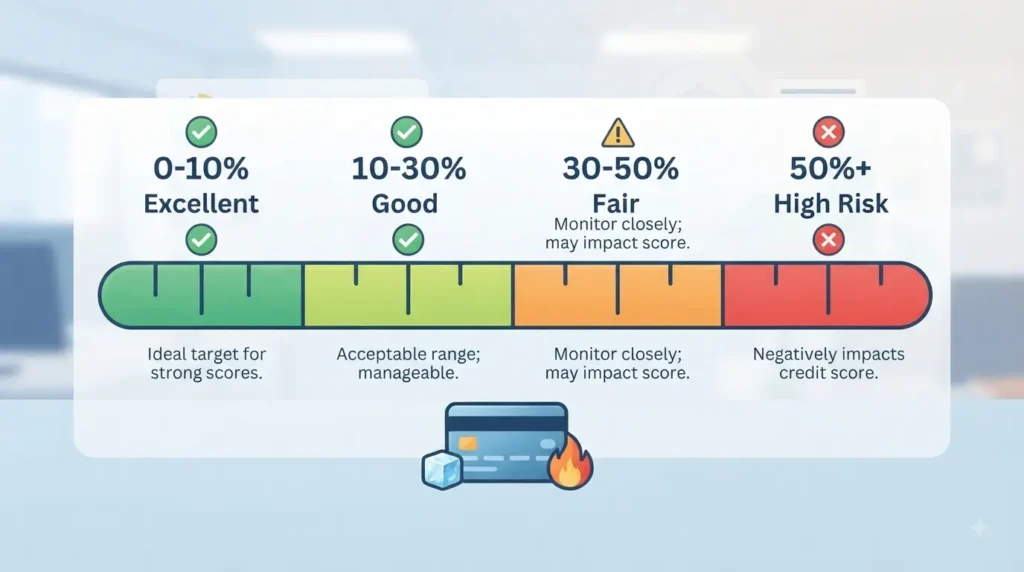
A practical way to think about it is:
- 0%: Not necessarily required
- Below 10%: Generally a strong target if practical
- 10%–30%: Often considered a reasonable range
- Above 30%: Worth paying closer attention to
- Very high utilization: Can put additional pressure on your credit profile
There is no universal percentage that guarantees a particular credit score.
Your complete credit history matters, and different scoring models can evaluate information differently.
Does 30% Utilization Really Matter?
The answer is a little more nuanced than many credit articles make it sound.
There isn’t a universal rule saying your credit score suddenly drops the moment your utilization reaches 30%.
FICO specifically notes that the effect varies by individual credit profile, and lower utilization can generally be better. Experian similarly describes 30% as a rule of thumb rather than a hard cutoff.
So instead of obsessing over one exact number, focus on keeping your balances comfortably below your available limits.
If you can reduce a card from 70% utilization to 25%, that’s generally more meaningful than worrying about whether you are at 8% or 11%.
Does Carrying a Credit Card Balance Help Your Credit Score?
This is one of the most common credit myths.
You don’t need to carry debt from one month to the next just to build credit.
Using a credit card responsibly and paying the balance according to your card’s terms can demonstrate responsible credit management. Carrying a balance can also mean paying interest, which doesn’t provide a special credit-building benefit.
FICO’s recent guidance also emphasizes that debt and utilization are not the same thing. You can use your credit card, keep utilization low, and pay your balance without deliberately carrying expensive debt.
So don’t keep a balance simply because someone told you it will increase your credit score.
When Is Credit Card Utilization Reported?
Your credit card balance isn’t necessarily reported to the credit bureaus at the exact moment you make a purchase or pay your bill.
Card issuers often report account information around the end of the statement period, although reporting practices can vary by issuer.
That means your card could be paid in full by the payment due date but still have a balance reported to the credit bureaus if the balance was present when the issuer reported the account.
Experian notes that issuers often send updates around the end of the statement period, which may be before the payment due date.
This is why understanding your statement cycle can be useful if you’re trying to manage reported utilization.
7 Practical Ways to Lower Your Credit Utilization Ratio
If your utilization is higher than you’d like, you have several options.
1. Pay Down High-Interest Card Balances
Start with the cards carrying the largest balances or highest interest costs.
Reducing a balance directly lowers the amount of credit you’re using.
If you want a broader guide to improving your credit profile, see our guide on how to improve your credit score fast.
2. Make Payments Before Your Statement Closes
You don’t always have to wait until the payment due date to make a payment.
If your balance is getting high, making an additional payment before the statement closes may reduce the balance that gets reported.
The exact reporting date depends on the issuer, so check your account information rather than assuming every card works the same way.
3. Spread Spending Across Available Credit
If you have several cards and one card is close to its limit, putting every purchase on that card can create a high individual utilization ratio.
Where appropriate, managing spending across your available credit may prevent one card from becoming heavily utilized.
This does not mean you should spend more simply to spread balances around.
The goal is responsible spending, not using every available account.
4. Avoid Maxing Out Your Cards
A card that is close to its limit can produce a very high utilization ratio.
Even if you intend to pay the balance later, the reported balance can still affect the information used by scoring models.
Keeping a reasonable buffer below your credit limit gives you more flexibility.
5. Consider a Credit Limit Increase Carefully
A higher credit limit can reduce your utilization if your balance stays the same.
For example:
$2,000 balance ÷ $5,000 limit = 40%
But if the limit increases to $10,000:
$2,000 ÷ $10,000 = 20%
The balance didn’t change. The available credit did.
FICO notes that a lender increasing a credit limit may lower utilization and, in some cases, may help a score.
However, don’t request a higher limit simply to spend more. Also check whether the issuer will perform a hard inquiry before requesting an increase.
6. Keep Unused Credit Accounts Open When Appropriate
Closing a credit card can reduce your total available revolving credit, which may increase your overall utilization if you still carry balances elsewhere.
For example, if you have $2,000 in balances and $10,000 in total limits, your utilization is 20%.
If a closed account removes $5,000 of available credit, your remaining utilization could become:
$2,000 ÷ $5,000 = 40%
That’s a major change even though your debt didn’t increase.
Closing accounts can have other effects as well, so don’t close a card solely because you aren’t using it without considering the broader picture. FICO notes that closing an account can raise utilization by removing available credit.
7. Monitor Both Your Balance and Credit Limit
Don’t only look at the minimum payment.
Check:
- Current balance
- Credit limit
- Statement balance
- Available credit
- Reported balance when available
This makes it easier to understand what may eventually appear on your credit report.
Can Lowering Credit Utilization Improve Your Credit Score Quickly?
It can, but there is no guaranteed number of points or exact timeline.
One reason utilization can change relatively quickly is that credit scoring models can use recently reported account information. If your reported balances fall, your utilization may fall as well.
That doesn’t mean every person will see an immediate score increase.
Your credit score is based on multiple factors, and the impact of a utilization change depends on your overall credit profile and the scoring model being used.
If you’re specifically working toward a short-term credit improvement goal, you can also read our guide to improving your credit score in 30 days.
What Happens If Your Credit Utilization Is 100%?
A 100% utilization ratio means your reported balance is equal to your credit limit.
For example:
$5,000 balance ÷ $5,000 credit limit = 100%
This means you’ve used the entire available limit on that account.
High utilization can hurt your credit score, and the closer utilization gets to maxing out a card, the more concerning it can be from a credit-scoring perspective.
If you’re dealing with a maxed-out card, focus first on bringing the balance down and keeping payments current rather than trying to chase a perfect utilization percentage.
Does a 0% Credit Utilization Ratio Help?
Not necessarily.
It might seem logical that 0% utilization is always best, but credit scoring is more complicated than that.
FICO notes that very low utilization can be beneficial, while 0% utilization may not necessarily produce the maximum possible score because it provides less information about current credit use.
The important point is that you don’t need to carry debt to show responsible credit use.
Using credit occasionally, keeping balances manageable, and paying responsibly is a healthier approach than deliberately carrying interest-bearing debt.
Credit Utilization vs. Paying Off Debt
These two ideas are connected, but they aren’t exactly the same.
You can have a high credit utilization ratio without being deeply in debt overall.
For example, someone with a $1,000 credit limit and a $700 balance has 70% utilization, even though the dollar amount isn’t enormous.
On the other hand, someone could have significant installment debt, such as a mortgage or auto loan, without having high credit card utilization.
That’s why you shouldn’t look at your credit card utilization in isolation.
It’s one part of your overall credit profile.
Common Credit Utilization Mistakes to Avoid
A few mistakes can make managing utilization harder than it needs to be.
Mistake 1: Treating 30% as a magic cutoff
30% is a useful benchmark, not a guaranteed scoring threshold.
Mistake 2: Carrying interest-bearing debt just to build credit
You don’t need to pay interest to demonstrate responsible credit management.
Mistake 3: Looking only at total utilization
Individual card utilization can matter too.
Mistake 4: Ignoring statement dates
Your reported balance may differ from the balance you see on a different day.
Mistake 5: Closing cards without considering available credit
Closing an account can reduce your total available credit and potentially increase your utilization.
Mistake 6: Applying for unnecessary new credit
A new account may increase available credit eventually, but opening accounts solely to manipulate utilization isn’t a good financial strategy.
Smart Takeaway: Keep Credit Utilization Low, But Don’t Obsess Over One Number
Your credit utilization ratio is one of the more manageable parts of your credit profile.
You don’t need to memorize complicated formulas.
Just remember:
Utilization = balance ÷ credit limit × 100
The lower your utilization generally is, the better it tends to be for your credit profile. But don’t treat 30% as a magic line or assume that a particular percentage guarantees a particular credit score.
Focus on the habits that actually matter:
- Keep credit card balances manageable.
- Pay bills on time.
- Avoid maxing out cards.
- Monitor individual and overall utilization.
- Understand when your issuer reports balances.
- Don’t carry expensive debt just to build credit.
Credit improvement is usually less about finding a secret trick and more about understanding how your accounts are reported and managing them consistently.
Final Thoughts
Understanding your credit utilization ratio can make managing your credit much easier.
You don’t need to chase a perfect number or carry a balance just to build your credit. Instead, keep your balances under control, understand your credit limits, make payments on time, and pay attention to what gets reported.
If you’re already working on improving your credit score, lowering utilization can be one practical area to focus on.
And remember, a credit score is built from your overall credit behavior, not one number alone.
Frequently Asked Questions (FAQs)
There is no single percentage that guarantees a good credit score. A lower utilization ratio is generally better, and keeping utilization below 30% is often used as a practical benchmark. People with very strong credit scores frequently have utilization in the single digits.
Not necessarily, and 30% should not be treated as a hard cutoff. However, lower utilization is generally better for credit scoring, so reducing a high balance can be useful when practical.
Divide your credit card balance by your credit limit and multiply the result by 100.
For example:
$500 ÷ $2,000 × 100 = 25%
Your utilization would be 25%.
Yes. Utilization is part of the FICO “Amounts Owed” category, which accounts for roughly 30% of a typical FICO Score. Utilization is only one component of that category, however.
Yes. Paying down your credit card balance lowers the amount of credit you’re using relative to your limit. However, the balance that appears on your credit report depends on when your card issuer reports account information.
Not necessarily. Lower utilization is generally beneficial, but FICO notes that 0% utilization isn’t automatically the best target for maximizing a score. You don’t need to carry debt to demonstrate responsible credit use.
It can. If closing the card removes available credit while your other balances remain unchanged, your overall utilization can increase.
Your utilization can change when the balances and limits reported to the credit bureaus change. Because issuers may report at different times, the exact timing varies.