If you’re struggling with multiple debts, you’ve probably come across two terms: debt consolidation and debt settlement.
They may sound similar, but they are very different approaches.
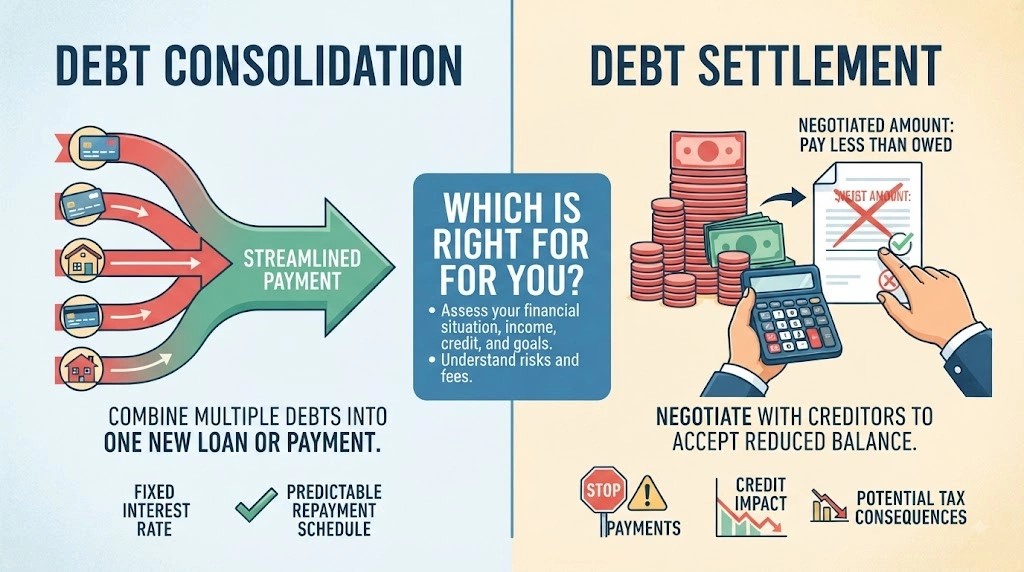
Debt consolidation generally means combining multiple debts into one new payment, often through a consolidation loan or another consolidation method. Debt settlement, on the other hand, involves trying to negotiate with creditors or debt collectors to accept less than the full amount owed.
That difference matters.
One strategy is primarily about reorganizing how you repay your debt. The other is about negotiating the amount you ultimately repay.
Neither option is automatically right for everyone.
In this guide, I’ll explain the difference between debt consolidation and debt settlement, how each works, the potential costs and risks, and what to consider before choosing either approach.
Debt Consolidation vs. Debt Settlement at a Glance
Here’s the simplest way to understand the difference:
| Debt Consolidation | Debt Settlement | |
|---|---|---|
| Main goal | Combine multiple debts into one payment | Negotiate to pay less than the amount owed |
| How it works | New loan or another method pays off existing debts | Creditor agrees to accept a negotiated amount |
| Do you still repay debt? | Yes, usually in full under the new terms | Potentially less than the original balance |
| Credit impact | Can vary depending on how you manage the new account | Can be negative, especially if payments are stopped |
| Interest | May be lower than existing debts, depending on terms | Interest and fees may continue while debts remain unpaid |
| Fees | May include loan or transfer fees | Settlement companies may charge fees |
| Main risk | Paying more over a longer term or taking on new debt without changing spending | Credit damage, additional fees, collection activity, lawsuits, and unsuccessful settlements |
| Best suited for | People who can repay their debt but need simpler or potentially better terms | People with serious unsecured debt who are considering negotiation after other options |
The biggest difference is simple:
Debt consolidation changes how you repay the debt. Debt settlement attempts to change how much you repay.
What Is Debt Consolidation?
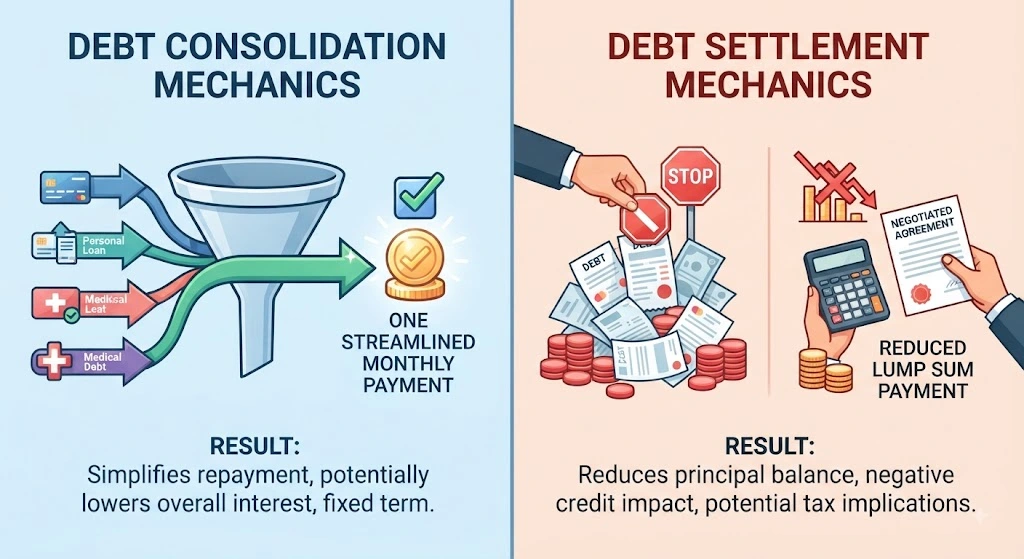
Debt consolidation means combining multiple debts into one payment.
For example, imagine you have:
- $4,000 on Credit Card A
- $3,000 on Credit Card B
- $2,000 on Credit Card C
Instead of making three separate payments, you might use a debt consolidation loan to pay those balances and then make one payment toward the new loan.
Banks, credit unions, and other lenders may offer debt consolidation loans. Other forms of consolidation can include balance-transfer credit cards or certain home-equity products.
The important thing is that consolidation doesn’t make the debt disappear.
You’re generally still responsible for repaying what you owe, but the debt may now have a different interest rate, payment schedule, or structure.
How Does Debt Consolidation Work?
The process can look something like this:
Step 1: Add Up Your Existing Debt
Start with every debt you want to consolidate.
Write down:
- Current balance
- Interest rate
- Minimum payment
- Remaining repayment period
- Any fees
Don’t make a decision based only on the monthly payment.
Step 2: Compare Consolidation Options
Depending on your situation, you might look at:
- Personal consolidation loans
- Balance-transfer credit cards
- Credit union loans
- Other legitimate consolidation products
Each option can have different rates, fees, and repayment periods.
Step 3: Compare the Total Cost
A lower monthly payment isn’t automatically a better deal.
A consolidation loan could reduce your monthly payment because it stretches repayment over a longer period. You could therefore pay more interest overall even though the monthly bill is smaller. The CFPB specifically warns consumers to consider the loan term, fees, and total cost rather than focusing only on the monthly payment.
Step 4: Pay Off the Existing Balances
If you take out a consolidation loan, the new funds are generally used to repay the debts you’re consolidating.
Step 5: Repay the New Debt
You now have one payment under the new agreement.
The biggest mistake would be paying off your cards and then immediately building new balances on them.
If the underlying spending problem isn’t addressed, consolidation can simply move the debt around rather than solve the problem. The CFPB makes this point directly in its consumer guidance.
What Is Debt Settlement?
Debt settlement is different.
Instead of combining debts into a new loan, settlement involves trying to negotiate with a creditor or debt collector to accept less than the full amount owed.
For example, imagine you owe $10,000.
A creditor might agree to accept a lower amount to resolve the account, depending on the circumstances.
However, settlement is not guaranteed.
Creditors don’t have to accept a settlement offer, and settlement companies cannot guarantee that they will settle all your debts or save you a particular percentage.
This is one reason debt settlement can carry significant risks.
How Does Debt Settlement Work?
A typical settlement process may involve:
Step 1: Reviewing Your Debts
You need to understand exactly what you owe, who you owe it to, and whether the debt is current or already delinquent.
Step 2: Building a Settlement Amount
A settlement arrangement may involve setting aside money that can eventually be used to make negotiated payments.
Step 3: Negotiating With Creditors
You or a settlement company may approach creditors or debt collectors and propose a settlement.
Step 4: Reaching an Agreement
If the creditor agrees, make sure the terms are documented in writing before making the agreed payment.
The CFPB recommends getting a settlement or repayment agreement in writing before paying.
Step 5: Completing the Settlement
Once the agreed amount has been paid according to the agreement, the debt may be resolved under those terms.
But remember: not every debt will necessarily be settled.
Debt Consolidation vs. Debt Settlement: The Biggest Differences
Now let’s look at the areas that matter most.
1. You Usually Still Repay the Full Debt With Consolidation
Debt consolidation doesn’t normally reduce the principal you owe.
Instead, you’re moving or restructuring the debt.
For example:
Before consolidation:
3 credit cards → 3 payments
After consolidation:
1 consolidation loan → 1 payment
You still owe the money.
With debt settlement, the objective is different. The negotiation may result in a creditor accepting less than the original balance.
That’s why settlement can sound more attractive — but the potential risks are also greater.
2. Debt Consolidation Can Simplify Your Payments
Managing five different credit cards can be difficult.
You have:
- Multiple due dates
- Multiple interest rates
- Multiple minimum payments
- Different account balances
Consolidation can turn that into one payment.
That simplicity can make budgeting easier.
However, simplicity alone isn’t enough reason to take out a consolidation loan. You still need to compare the total cost and make sure the new terms actually improve your situation.
3. Debt Settlement Can Damage Your Credit
This is one of the biggest differences.
Many debt settlement programs encourage consumers to stop making payments to creditors while money is accumulated for settlements.
The CFPB warns that stopping payments can result in late fees, additional interest, collection activity, credit damage, and even lawsuits.
That’s very different from simply taking out a consolidation loan and continuing to make payments.
If protecting your credit profile is a major priority, understand this risk before considering settlement.
If you’re already working on your credit, you can also read our guide on how to improve your credit score fast.
4. Debt Consolidation Can Still Cost More Than Expected
Consolidation isn’t automatically cheaper.
Suppose your current debts have high interest rates, but a consolidation loan offers a lower rate.
That sounds good.
But then you notice the new loan lasts several years instead of the shorter repayment period you originally had.
Your monthly payment may decrease, but you could end up paying more interest over the entire loan.
The CFPB specifically recommends looking at the full repayment period, fees, and total cost rather than assuming a lower monthly payment means a cheaper loan.
5. Debt Settlement Companies Can Charge Fees
If you work with a debt settlement company, understand exactly how it gets paid.
Be especially careful with companies asking for large upfront fees or making guaranteed promises.
The FTC and CFPB warn consumers about debt settlement companies that promise guaranteed results, demand upfront fees, or tell consumers to stop communicating with creditors.
A company saying:
“We’ll eliminate all your debt.”
should immediately make you cautious.
There is no legitimate shortcut that guarantees every debt can be settled.
6. Tax Consequences Can Be Different
Debt settlement can create another issue that people sometimes overlook.
If a creditor forgives part of your debt, the amount forgiven may potentially be treated as taxable income, depending on the circumstances.
The FTC specifically warns that savings from debt settlement can potentially be considered income for tax purposes.
That doesn’t mean every forgiven amount will automatically create a tax bill.
Your individual circumstances matter, so consider speaking with a qualified tax professional if you’re considering a settlement involving significant debt forgiveness.
When Might Debt Consolidation Make Sense?
Debt consolidation may be worth considering if:
- You have multiple high-interest debts.
- Your income is stable enough to support repayment.
- You qualify for better terms than your existing debts.
- You want to simplify several payments.
- You have a realistic budget.
- You understand the total cost of the new loan.
- You are prepared not to build new balances after consolidation.
Your credit profile can also affect what consolidation products and interest rates you qualify for.
If your credit has already been affected by high balances or missed payments, you may not qualify for the most attractive offers.
When Might Debt Settlement Be Considered?
Debt settlement is generally a much more serious decision.
It may be considered when:
- Your unsecured debt is genuinely difficult to repay.
- You’ve already looked at less risky options.
- You understand the potential credit consequences.
- You understand that creditors may refuse to settle.
- You can afford the proposed settlement payments.
- You’ve reviewed the fees and terms carefully.
- You understand the possible tax consequences.
It should not be treated as a quick way to get a discount on ordinary credit card debt.
The CFPB specifically recommends considering alternatives such as nonprofit credit counseling and contacting creditors directly before working with a debt settlement company.
Debt Consolidation vs. Debt Settlement: Which Is Better?
There isn’t one answer that works for everyone.
A useful way to think about it is:
Consolidation may be more suitable if:
You can afford to repay your debt, but the current structure is difficult.
You might benefit from:
- One payment instead of several
- Potentially lower interest
- A predictable repayment schedule
- Easier budgeting
Settlement may be considered if:
Your debt has become genuinely difficult to repay, and you’re exploring negotiation after considering other options.
But you need to accept that settlement can involve:
- Credit damage
- Additional fees and interest
- Collection activity
- Possible lawsuits
- No guarantee of successful settlement
- Possible tax consequences
The difference is important:
Consolidation is generally about making repayment more manageable. Settlement is about negotiating the amount that gets repaid.
What Should You Try Before Debt Settlement?
Before jumping into settlement, consider less drastic options.
Talk to Your Creditors
If you’re struggling to make payments, contact your creditors directly.
Some creditors may be willing to discuss options such as lower payments, fee changes, or different payment arrangements. The CFPB recommends contacting creditors when you’re having difficulty paying.
Review Your Budget
Add up:
- Monthly income
- Housing
- Utilities
- Food
- Transportation
- Debt payments
- Insurance
- Other necessary expenses
Then determine how much you can realistically dedicate to debt repayment.
Consider Nonprofit Credit Counseling
A nonprofit credit counselor can review your overall financial situation and help you understand available repayment options.
The CFPB says credit counseling organizations generally focus on helping consumers manage money and debt, and may help establish a debt management plan.
You can also read our broader guide to debt relief options.
Warning Signs of a Debt Relief Scam
Be careful if a company:
- Guarantees it can eliminate your debt.
- Promises a specific percentage of savings.
- Demands significant fees before settling your debt.
- Tells you to stop communicating with creditors.
- Tells you to stop making payments without clearly explaining the consequences.
- Claims there is a special government program that will erase your credit card debt.
- Guarantees that lawsuits or collection calls will stop.
The FTC has specifically warned consumers about these types of debt-relief promises.
If an offer sounds too good to be true, slow down before giving the company your money or financial information.
A Simple Example
Let’s say you have:
Credit Card A: $5,000
Credit Card B: $4,000
Credit Card C: $3,000
Total debt:
$12,000
With debt consolidation
You could potentially use a new loan to pay the three balances.
Instead of:
3 creditors → 3 payments
you have:
1 lender → 1 payment
You still owe approximately $12,000, plus any applicable interest and fees under the new loan.
With debt settlement
You might attempt to negotiate with creditors to accept less than the amount owed.
If a creditor agreed to accept $7,500 to resolve a $10,000 debt, the remaining amount could potentially be forgiven under the settlement agreement.
But that doesn’t mean you automatically save $2,500.
You have to consider:
- Settlement fees
- Interest and late fees
- Credit damage
- Whether all creditors agree
- Possible tax consequences
- Whether you can actually complete the settlement
That’s why comparing the headline “savings” isn’t enough.
A Quick Decision Checklist
Before choosing either option, ask yourself:
About your debt
- How much do I owe in total?
- What are my current interest rates?
- How many creditors do I have?
- Are my accounts current or already delinquent?
About your income
- Is my income stable?
- How much can I realistically pay each month?
- Do I have an emergency fund?
If considering consolidation
- What is the new interest rate?
- Is the rate fixed or promotional?
- What fees will I pay?
- How long will repayment take?
- What is the total amount I’ll repay?
If considering settlement
- What fees will the company charge?
- Are the fees charged upfront?
- What happens if a creditor refuses to settle?
- What happens to my credit while I’m waiting?
- Could forgiven debt have tax consequences?
- Is the settlement agreement in writing?
Smart Takeaway: Consolidation and Settlement Are Not the Same Thing
Debt consolidation and debt settlement are often grouped together under “debt relief,” but they solve different problems.
Debt consolidation is generally about combining debts into a simpler repayment structure. It may make sense when you have the income and credit profile to qualify for better terms and can commit to paying the new debt responsibly.
Debt settlement is about negotiating with creditors to potentially resolve debts for less than the full amount owed. It can carry much greater risks, particularly when programs involve stopping payments.
Before choosing either one, look at your complete financial situation.
Don’t choose an option simply because an advertisement promises a lower payment or a dramatic reduction in your debt.
Understand the interest, fees, credit consequences, repayment timeline, and risks first.
And if you’re unsure, consider speaking with a qualified nonprofit credit counselor or another appropriate financial professional before making a major decision.
Final Thoughts
Debt can feel overwhelming when every account has a different balance, interest rate, and due date.
That’s why debt consolidation can be attractive: it may simplify the repayment process and, depending on the terms, potentially reduce the cost of borrowing.
Debt settlement is a different path. It may offer a way to negotiate certain debts, but it comes with significant risks that shouldn’t be overlooked.
The best decision isn’t necessarily the option with the lowest advertised monthly payment or the biggest promised discount.
It’s the option that fits your actual income, debt, credit situation, and ability to follow through.
Understand the numbers first. Then choose the strategy.
Frequently Asked Questions
No. Debt consolidation generally combines multiple debts into one repayment structure, while debt settlement involves negotiating with creditors or debt collectors to accept less than the amount owed.
Usually, no. Consolidation generally restructures or combines your existing debt rather than eliminating the principal you owe.
It can. Debt settlement programs may involve missed or stopped payments, which can lead to negative credit reporting, collection activity, and other consequences.
There isn’t a universal answer. Consolidation may reduce interest costs but can also involve fees or a longer repayment period. Settlement may reduce the amount paid to a creditor but can involve settlement fees, accumulated interest, credit damage, and potential tax consequences.
It may be possible, but the terms you qualify for can depend on your credit profile, income, debt, and the lender. People with weaker credit may not qualify for the lowest advertised rates.
Not necessarily. It depends on the consolidation method and your individual agreements. If you consolidate credit card balances into a new loan, the original cards may remain open unless you or the issuer closes them.
Yes, you can contact creditors or debt collectors yourself and attempt to negotiate. If you reach an agreement, the CFPB recommends getting the terms in writing before making the payment.
They should not. Creditors may refuse to settle, and a settlement company cannot guarantee that it will settle all your debts or achieve a specific amount of savings.
Don’t make that decision based solely on a company’s promise. Stopping payments can lead to late fees, additional interest, credit damage, collection efforts, and potentially lawsuits. Understand the consequences and consider getting independent advice first.
It can be, depending on the circumstances. Debt forgiveness may potentially be treated as taxable income, so consider discussing your situation with a qualified tax professional.
Consider reviewing your budget, contacting your creditors directly, and speaking with a nonprofit credit counselor. These options may help you find a repayment strategy without taking on some of the risks associated with settlement.