How to Read Your Credit Report
Your credit report can tell you a lot about your financial history, but only if you know what you’re looking at.
It contains information about your credit accounts, payment history, balances, credit limits, inquiries, and other details that can be used by credit reporting companies to create your credit profile.
The problem is that even a small mistake can cause confusion.
An account that isn’t yours, an incorrect balance, a payment incorrectly marked as late, or an old account listed incorrectly can all be worth investigating.
That’s why checking your credit report isn’t something you should only do when you’re applying for a loan or credit card.
In this guide, I’ll show you how to read your credit report, what information to check, which errors are common, and what to do if you find something that isn’t accurate.
What Is a Credit Report?
A credit report is a record of information about your credit history.
Credit reporting companies collect information from businesses that report your credit activity and organize that information into a report.
Lenders and other permitted businesses may use information from your credit report when evaluating applications for credit and other services.
Your credit report is different from your credit score.
Your report contains the underlying information, while a credit score is calculated using information from your credit history.
That’s an important difference.
If your report contains inaccurate information, the problem may affect the information used to calculate your score.
The CFPB specifically recommends reviewing your credit reports because mistakes can affect your credit history and score.
How to Get Your Credit Report
If you’re checking your credit report, start with the official source rather than a website promising a “free” report in exchange for unnecessary services.
For U.S. consumers, the official source is AnnualCreditReport.com.
The FTC says consumers can obtain free credit reports from the three major nationwide credit reporting companies, and the agencies have also made weekly online access available through AnnualCreditReport.com.
The three major credit reporting companies are:
- Equifax
- Experian
- TransUnion
It’s useful to review reports from all three because the information may not be identical across every report.
The CFPB also recommends checking each report for inaccurate or incomplete information.
Tip: Avoid confusing your credit report with paid credit-monitoring products. You don’t have to pay a company simply to review your own credit report.
What Information Is on a Credit Report?
Once you open your report, it can look complicated at first.
Don’t worry about understanding every code immediately.
Start by looking at the major sections.
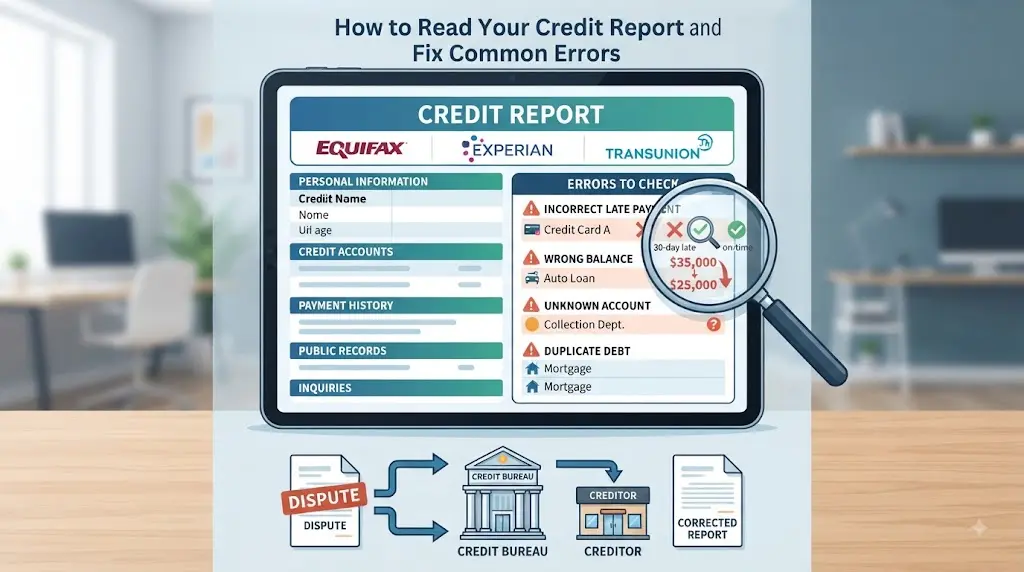
1. Personal Information
This section can include information such as:
- Your name
- Previous names
- Current or previous addresses
- Phone numbers
- Other identifying information
You should check this section carefully.
A wrong address might seem harmless, but incorrect identity information can sometimes indicate that your file contains mixed information belonging to another person.
The CFPB specifically recommends checking for incorrect names, phone numbers, addresses, and accounts belonging to someone else.
2. Credit Accounts
This is one of the most important sections of your credit report.
You may see:
- Credit cards
- Personal loans
- Auto loans
- Mortgages
- Other reported credit accounts
For each account, look at the details carefully.
Check:
- Account name
- Account type
- Account status
- Date opened
- Credit limit
- Current balance
- Payment history
- Whether the account is open or closed
Ask yourself a simple question:
Do I recognize this account?
If you don’t, don’t immediately assume it’s a reporting error.
It could be an account reported under a different creditor name, or it could be a sign of identity theft.
Investigate it before ignoring it.
3. Payment History
Your payment history shows how your accounts have been reported over time.
Look for:
- On-time payments
- Late payments
- Delinquencies
- Accounts in collection
- Incorrect payment dates
For example, suppose you know you paid a credit card on time, but your report says the payment was late.
That’s something worth investigating.
The CFPB lists incorrectly reported late or delinquent accounts as one of the common credit-report errors consumers should look for.
4. Credit Limits and Balances
Your report may show the credit limit and current balance for revolving accounts.
Check that both numbers make sense.
An incorrect credit limit can be particularly important because it can affect how your credit utilization appears.
For example, imagine your actual credit limit is $10,000 but your report shows only $5,000.
If you have a $2,000 balance, your utilization could appear as:
$2,000 ÷ $5,000 = 40%
But if the correct limit is $10,000:
$2,000 ÷ $10,000 = 20%
That’s why credit-report accuracy and credit utilization are closely connected.
If you want to understand that relationship in more detail, read our guide on credit utilization ratio.
5. Collections and Negative Information
Your report may contain information about accounts that became seriously delinquent or were sent to collections.
Don’t automatically dispute negative information simply because you don’t like seeing it.
There’s an important difference between:
Incorrect negative information
and
Accurate negative information
If information is accurate, you generally cannot have it removed simply because it hurts your credit.
The CFPB says accurate negative information generally cannot be removed, while inaccurate, incomplete, duplicated, or identity-theft-related information can be disputed.
That’s an important distinction to understand before contacting a credit-repair company.
6. Hard and Soft Inquiries
Your credit report can also show inquiries made when someone checks your credit.
There are generally two types:
Hard inquiries
These can occur when you apply for credit and may affect your credit score.
Soft inquiries
These can occur when you check your own credit or when a company checks your credit for certain purposes. They generally don’t affect your score.
If you see an inquiry you don’t recognize, investigate it.
An unfamiliar inquiry doesn’t automatically prove identity theft, but it is worth checking.
10 Common Credit Report Errors to Look For
Now that you know the basic sections, it’s time to look for mistakes.
Here are some of the most common ones.
1. An Account That Isn’t Yours
You may see a credit card, loan, or collection account that you don’t recognize.
This could happen because of:
- Identity theft
- Mixed files
- Reporting mistakes
- Confusion between similar names
Don’t ignore unfamiliar accounts.
The CFPB specifically recommends checking that your report contains only information about you.
2. Incorrect Name or Address
Check whether your identifying information is accurate.
A minor typo isn’t necessarily a serious credit problem, but multiple identity details that don’t belong to you deserve attention.
3. Incorrect Late Payment
If an account says you missed a payment but you have records showing that you paid on time, gather your documentation.
Payment records, account statements, and other supporting documents can help when disputing inaccurate information.
4. Closed Account Listed as Open
If you’ve already closed an account, check whether the report correctly reflects its status.
The CFPB lists closed accounts incorrectly reported as open as a common credit-report error.
5. Incorrect Account Ownership
Sometimes an account may identify you as the primary account holder when you’re actually an authorized user.
That difference matters.
Check the account ownership details when reviewing your report.
6. Wrong Balance
Compare the balance on your report with your account records.
If the numbers don’t match, check when the credit report was updated before assuming there is an error.
Balances can change over time, so a different number isn’t automatically inaccurate.
7. Incorrect Credit Limit
An incorrect credit limit can affect how your utilization appears.
If the reported limit is lower than your actual limit, your utilization may look higher than it really is.
8. Duplicate Debt
Sometimes the same debt can appear more than once.
The CFPB lists duplicate accounts or debts as one of the errors consumers should look for when reviewing their reports.
Before disputing a duplicate, make sure the entries actually represent the same debt and aren’t separate accounts with similar names.
9. Incorrect Dates
Check important dates such as:
- Account opening date
- Last payment date
- First delinquency date
- Account closing date
An incorrect date can affect how an account appears in your credit history.
10. Identity Theft Information
An account you never opened or a debt you don’t recognize could be a sign of identity theft.
If you believe identity theft is involved, don’t treat it like an ordinary reporting mistake.
The FTC recommends using IdentityTheft.gov to report identity theft and receive a recovery plan.
How to Dispute an Error on Your Credit Report
Finding an error is only the first step.
If the information is genuinely inaccurate or incomplete, you can dispute it.
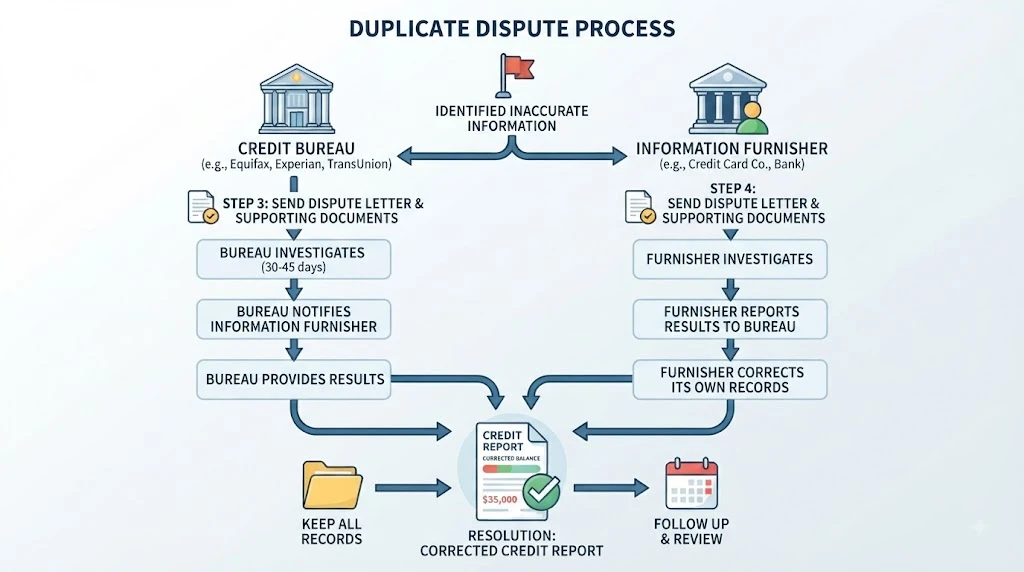
The CFPB recommends contacting both:
- The credit reporting company that shows the error
- The company that provided the information
That second company is often called the furnisher.
Disputing with both parties can help make sure the issue is investigated from both sides.
Step 1: Identify Exactly What Is Wrong
Don’t send a vague message saying:
“My credit report is wrong.”
Be specific.
For example:
“The account shows a late payment for March 2026, but my records show the payment was made on March 12, 2026.”
Specific information makes your dispute easier to understand.
Step 2: Gather Supporting Documents
Collect anything that supports your claim.
Depending on the issue, this could include:
- Account statements
- Payment confirmations
- Bank records
- Letters from the lender
- Proof of identity
- Other relevant documentation
Send copies rather than original documents when submitting a dispute. The CFPB recommends including copies of documents supporting your position.
Step 3: Dispute the Error With the Credit Bureau
Follow the dispute instructions provided with your credit report or through the credit reporting company’s official dispute process.
Explain:
- What information is wrong
- Why it is wrong
- What you want corrected
- Which documents support your claim
If you send a dispute by mail, the CFPB recommends keeping records of what you send. Certified mail with a return receipt can also give you proof that the dispute was received.
Step 4: Contact the Company That Reported the Information
Don’t stop with the credit bureau.
If a credit card company, lender, collection agency, or other business supplied the incorrect information, dispute it with that company as well.
The CFPB specifically recommends disputing inaccurate information with both the reporting company and the information provider.
Step 5: Keep Every Record
Create a simple folder for your dispute.
Keep:
- Your original credit report
- Copies of dispute letters
- Documents you submitted
- Emails
- Confirmation numbers
- Responses
- Updated reports
This becomes extremely useful if you need to follow up later.
How Long Does a Credit Report Dispute Take?
The credit reporting company generally has 30 days to investigate a dispute, although there are circumstances where the investigation period can extend. The FTC explains that the bureau must investigate and provide the results, and the process can involve the company that supplied the disputed information.
So don’t assume that submitting a dispute means the error will disappear immediately.
After the investigation, review your updated information to make sure the correction was actually made.
What If the Credit Bureau Says the Information Is Accurate?
This can happen.
If the investigation determines that the information is accurate, the item generally won’t be removed simply because you disagree with it.
But if you still believe the information is wrong, you have options.
The CFPB says consumers may have the right to add a statement to their credit file explaining their dispute if the issue remains unresolved.
You can also review the evidence supporting your claim and contact the company that supplied the information.
The key is to distinguish between:
“I don’t like this information.”
and
“This information is inaccurate or incomplete.”
Only the second is a legitimate basis for disputing inaccurate reporting.
What If the Error Is Caused by Identity Theft?
Identity theft requires a different approach.
If someone opened an account in your name, used your personal information, or created debts you don’t recognize, start by reporting the identity theft.
The FTC directs consumers to IdentityTheft.gov, where you can report the issue and receive a personalized recovery plan.
You may need documentation showing that the account or debt resulted from identity theft.
Don’t pay a debt you know isn’t yours simply because you’re worried about your credit score.
Instead, document the situation and follow the appropriate identity-theft and dispute process.
Can You Remove Accurate Negative Information?
Usually, no.
This is where many people get misleading advice online.
If you genuinely missed payments or legitimately owe a debt, you generally cannot have accurate negative information removed just because it hurts your credit.
The CFPB warns consumers about companies that promise to remove accurate, current negative information from their reports.
Credit repair companies also cannot legally erase accurate negative information simply because you pay them.
If you’re considering paying someone to dispute information for you, first understand what you can do yourself.
How Often Should You Check Your Credit Report?
There isn’t one perfect schedule for everyone.
A practical approach is to check your reports regularly and especially before major financial decisions.
You may want to review your credit report before:
- Applying for a mortgage
- Applying for an auto loan
- Applying for a major credit card
- Renting a home
- Reviewing your overall financial health
Regular checking can also help you spot identity theft or reporting mistakes earlier.
The CFPB recommends regularly checking credit reports for errors.
What to Do After Fixing a Credit Report Error
Don’t assume the job is finished once you receive a dispute result.
Go back and check the report again.
Make sure:
- The incorrect account was corrected
- The payment history is accurate
- The balance is correct
- The account status is correct
- Duplicate information is gone
- Any identity-theft-related information was handled correctly
If the correction affects your credit utilization, review that as well.
For example, if a credit card’s limit was incorrectly reported as $5,000 and is corrected to $10,000, your reported utilization could change significantly.
That’s another reason your credit report and credit utilization ratio should be reviewed together.
A Simple Credit Report Review Checklist
When you sit down to review your report, use this checklist:
Personal Information
- Name is correct
- Address information looks familiar
- No unexpected identity information appears
Accounts
- Every account belongs to you
- Account status is correct
- Account type is correct
- Opening and closing dates look correct
Payments
- Payment history is accurate
- No false late payments appear
- Delinquencies are accurate
Balances
- Current balances look correct
- Credit limits are correct
- No duplicate accounts appear
Inquiries
- You recognize your hard inquiries
- No suspicious credit applications appear
Negative Information
- Collections belong to you
- Dates appear accurate
- Accurate negative information isn’t being confused with an error
Identity Theft
- No unfamiliar accounts exist
- No suspicious activity appears
- Identity-theft concerns are reported promptly
Smart Takeaway: Your Credit Report Deserves a Regular Check
Your credit report is more than a record you look at when you’re applying for a loan.
It gives you a picture of how your credit history is being reported.
A few minutes spent checking your accounts, balances, payment history, and personal information can help you catch problems before they become bigger headaches.
And if you find an error, don’t panic.
Document it, dispute it with the appropriate parties, keep your records, and check the report again after the investigation.
The goal isn’t to make every negative item disappear.
The goal is to make sure the information on your credit report is accurate, complete, and actually belongs to you.
Final Thoughts
Learning how to read your credit report doesn’t have to be complicated.
Start with the basics: check who you are listed as, review every account, verify payment history, compare balances and credit limits, and look closely at inquiries and negative information.
If something is wrong, don’t ignore it.
Gather your documents, dispute the inaccurate information with the credit reporting company and the company that reported it, and keep track of the process.
Your credit report is the foundation behind much of your credit profile. Keeping it accurate is one of the simplest ways to stay aware of your financial health.
Frequently Asked Questions (FAQs)
Start with your personal information, then review every credit account, payment history, balance, credit limit, collection account, and inquiry. The most important question is whether every piece of information is accurate and belongs to you.
For U.S. consumers, the official source is AnnualCreditReport.com. The FTC recommends using it to access your reports from the three major credit reporting companies.
Common errors include accounts that don’t belong to you, incorrect late payments, wrong balances or credit limits, closed accounts reported as open, duplicate debts, incorrect dates, and identity information that doesn’t belong to you.
Contact the credit reporting company showing the error and the company that supplied the information. Explain what is inaccurate, provide supporting documentation, and keep copies of everything you submit.
A credit reporting company generally has 30 days to investigate a dispute, although the exact process can vary depending on the circumstances.
If the late payment is inaccurate, you can dispute it. If the information is accurate, you generally cannot have it removed simply because it is negative.
First, investigate the account and check whether it could belong to you under a different creditor name. If you determine that it isn’t yours, dispute the information. If you suspect identity theft, report it through IdentityTheft.gov and follow the recovery steps.
No. Checking your own credit report is not the same as applying for new credit. The CFPB specifically states that requesting your credit reports will not hurt your credit score.
No. Only dispute information that you believe is inaccurate or incomplete. Accurate negative information generally cannot be removed simply because it hurts your credit.
Not necessarily. You have the legal right to dispute inaccurate information yourself, and the CFPB notes that consumers can dispute inaccuracies directly with the credit reporting company and the information provider.