
A woman sat across from me last spring, phone in hand, and asked me to guess her weight before she told me. Not her actual weight; what she thought her body should weigh, based on a chart she’d found online in 2011 and never questioned since.
That’s the session that got me thinking about this whole article, actually. Not because her number was wrong (it was), but because of how long she’d been carrying it around. Fourteen years. A number from a website that probably doesn’t even exist anymore, still running her life.
Most of my clients don’t come in lacking discipline. They come in loaded with rules. Rules about water, breakfast, fat, carbs, and detoxing—rules nobody ever double-checked, because they arrived wearing a lab coat and nobody thought to ask who actually wrote them.
So here’s what I want to do. I want to go through the ones I hear most, on repeat, in nearly every intake session I run and just tell you, plainly, what’s actually true. Some of these are going to surprise you. One or two might annoy you a little. That’s fine. Stick with me.
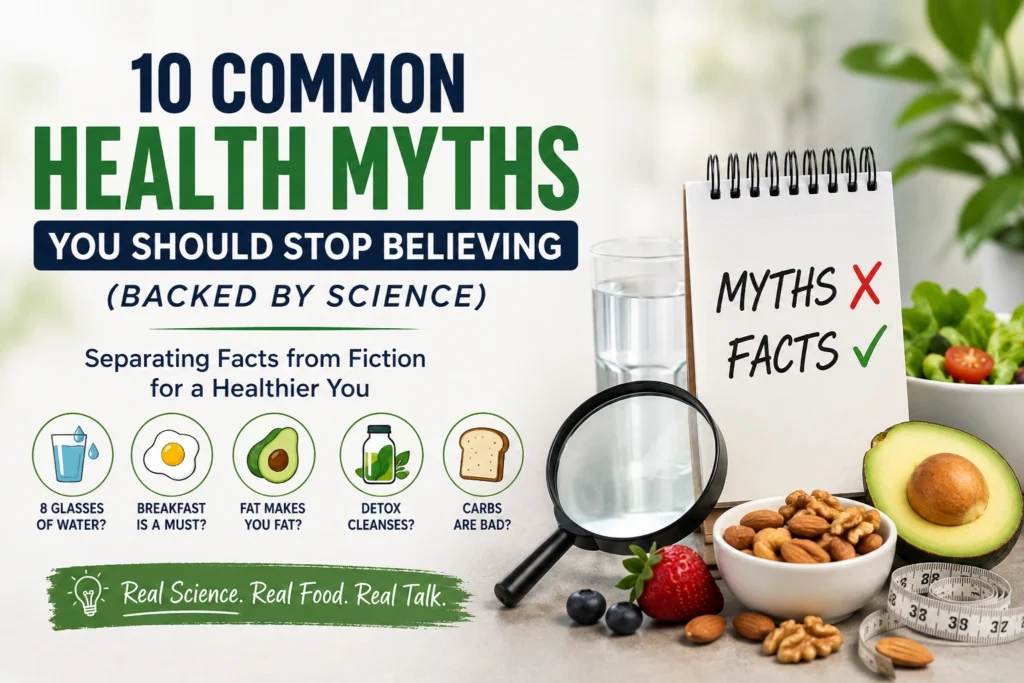
1. “Drink 8 Glasses of Water a Day” – Where Did That Even Come From?
Nobody knows, is the honest answer. Ask ten dietitians where the eight-glasses rule originated, and you’ll get ten different guesses, mostly wrong. The closest anyone’s traced it is a 1945 food board recommendation that included water from food, which somehow got lost in translation over eighty years of repetition until it became “eight cups, full stop.”
I had a client, a construction worker, outside in the Phoenix heat most of the year, who was drinking exactly eight glasses because that’s what he’d read. Eight glasses. In 108-degree weather. He needed closer to fourteen, and he had no idea, because the number he’d memorized had nothing to do with his actual life.
Compare him to someone working from a cool office who eats a lot of soup and fruit. That person might genuinely need less than eight. Water needs aren’t fixed. They move with your climate, your activity, your body size, whether you’re pregnant, even what you ate for lunch.
Forget the number. Watch your urine color; if it’s pale straw, you’re fine; if it’s dark apple juice, drink up. It’s crude, but it works better than any app.
2. Skipping Breakfast Won’t “Wreck” Anything
I believed this one myself for the first few years of my career, which is a little embarrassing to admit now.
Here’s what changed my mind: watching real people. Some of my clients eat breakfast at 6 a.m. and feel sharp all morning. Others — and this took me a while to accept — genuinely do better skipping it entirely and eating their first real meal closer to 1 p.m. Neither group is broken. They’re just different.
One client, a nurse on rotating night shifts, spent almost a year forcing down eggs at dawn because a magazine told her to. She hated every bite. We finally just… stopped. Moved her first meal to whenever her body actually asked for food. Her energy improved within two weeks. Not because breakfast is bad, but because her breakfast timing was wrong for her schedule.
What actually matters is what’s on the plate whenever you eat it. A muffin and a sugar-loaded latte at 7 a.m. isn’t doing anyone’s metabolism any favors, regardless of what time the clock says.
3. The Fat Myth That Refuses to Die
This is the one that genuinely gets under my skin, so bear with me for a second.
In the ’90s, “low-fat” got stamped on everything: yogurt, crackers, salad dressing, while food companies quietly replaced the fat with sugar to keep the taste from being cardboard. We ended up eating more sugar, gaining more weight, and somehow blaming fat the entire time. It’s one of the strangest self-inflicted wounds in modern nutrition history.
Avocados, olive oil, walnuts, and salmon these healthy fats aren’t just “not bad”; they’re actively doing work for your heart and your brain. What deserves the side-eye is trans fat, the stuff hiding in shelf-stable snack foods with ingredient lists you can’t pronounce.
I had one woman avoid peanut butter for literally a decade over this myth. A full decade. When we added a tablespoon back into her mornings, her afternoon hunger crashes — the ones that used to send her straight for vending machine chips — mostly disappeared. That’s not a coincidence. That’s fat doing its actual job: keeping you full.
4. Detox Teas Are Selling You Something Your Body Already Does for Free
Every January, without fail, someone asks me about a detox tea they saw on Instagram. Every January, I give roughly the same answer, and every January it lands like I’ve just told them Santa isn’t real.
Your liver and kidneys detox your body. Continuously. Right now, while you’re reading this. That’s their entire job description, and they’ve been doing it since before you were born, with zero help from a $38 box of tea leaves.
What most “detox” programs actually deliver is water loss and calorie restriction dressed up in wellness branding. You’ll feel lighter for a few days. Then you eat a normal meal, and it’s gone. If you actually want to support detoxification—real, ongoing, unglamorous detoxification—sleep enough, drink water, and eat fiber. That’s the whole list. I know it’s not exciting. It’s also what works.
5. Carbs Didn’t Do Anything to You
Somewhere along the way, carbohydrates got treated like a single villain, which never made sense to me, because oatmeal and a candy bar are both “carbs” and have almost nothing else in common.
Whole grains, fruit, vegetables, and legumes: these come bundled with fiber, and fiber is doing quiet, unglamorous work for your digestion and blood sugar the entire day. Refined carbs: white bread, crackers, most cereal—spike you fast and drop you faster, leaving you hungry an hour later, hunting for a snack.
I’ve watched clients cut carbs entirely, lose the fiber they needed, and end up more tired and more constipated, not leaner. Not exactly the transformation they were promised.
6. You Don’t Have to Sweat to Burn Fat
Sweat is a cooling mechanism. That’s genuinely all it is: your body regulating temperature. It has no direct relationship to how much fat you’re burning.
A person doing hot yoga for an hour might sweat through their shirt and burn fewer calories than someone taking a brisk 40-minute walk in cool October air without breaking a visible sweat. Most of what disappears during a sweaty session is water weight, and it’s back the second you drink a glass of water.
Judge a workout by how it challenges you, not by your laundry pile afterward.
7. More Protein Isn’t Automatically Better Protein
Protein matters! I’m not going to argue otherwise. But there’s a ceiling most people don’t realize exists.
Your body can only use so much at a given time to repair and build tissue. Past that point, extra protein gets treated like any other excess calorie stored or burned for energy; nothing magical happening beyond your actual daily requirement.
8. Supplements Are a Backup Plan, Not a Meal Plan
A multivitamin can patch a gap here and there. It cannot replace the fiber, antioxidants, and hundreds of plant compounds sitting in an actual vegetable. I’ve had clients treat their supplement drawer like an insurance policy against a genuinely poor diet, and it just doesn’t work that way. Food does things pills can’t replicate — full stop.
9. “Healthy” Foods Still Have Calories
Nuts, peanut butter, avocado — good foods, genuinely. Also dense ones. A tablespoon of peanut butter is roughly 90 calories, and it is very, very easy to eat four tablespoons standing at the counter without registering it as a decision. Healthy doesn’t mean unlimited. Portion size doesn’t disappear just because the food has a good reputation.
10. There’s No Single Food That Fixes You
Turmeric won’t save you. Neither will apple cider vinegar, celery juice, or whatever ingredient is trending this month. I genuinely wish one of them worked that way — my job would be a lot easier. What actually changes your health is the pattern you repeat, meal after meal, for months. Boring, I know. Also true.
What Actually Moves the Needle
If you want the short version, after everything above: eat mostly whole food, move your body in a way you don’t dread, sleep close to 8 hours, drink based on thirst and climate, deal with your stress instead of stuffing it down, get your check-ups, and stay suspicious of anything promising a fast result.
None of that fits neatly on a supplement label. That’s kind of the point.
Before You Go
That woman I mentioned at the start; the one carrying around a fourteen-year-old number from a website that probably doesn’t exist anymore? We didn’t fix everything in one session. But we threw out the number. That was the whole first step.
Most of the health myths in this article work the same way. They’re not evil; they’re not even always wrong exactly; they’re just old rules nobody’s re-checked in a while. Worth going through your own list every so often and asking where each one actually came from.
Small, unglamorous consistency beats every trend I’ve watched come and go in this field. And there’ve been a lot of them.
FAQs
No fixed number applies to everyone. Climate, activity level, and diet all shift your actual needs — thirst and urine color are more reliable guides than any chart.
Not really. Your liver and kidneys already run detoxification continuously. Most detox products just cause temporary water loss.
Not inherently. What matters more is the quality of what you eat across the whole day, not the exact hour you start eating.
Not on its own. Total calorie balance matters far more than any single nutrient like fat.
No — whole, fiber-rich carbs support digestion and steady energy. Refined carbs are the ones worth trimming back.
No. They fill small nutritional gaps but can’t replicate the fiber and compounds found in whole foods.
Detox teas, without question, are one of the most persistent health myths debunked by research, yet still marketed heavily every January.