
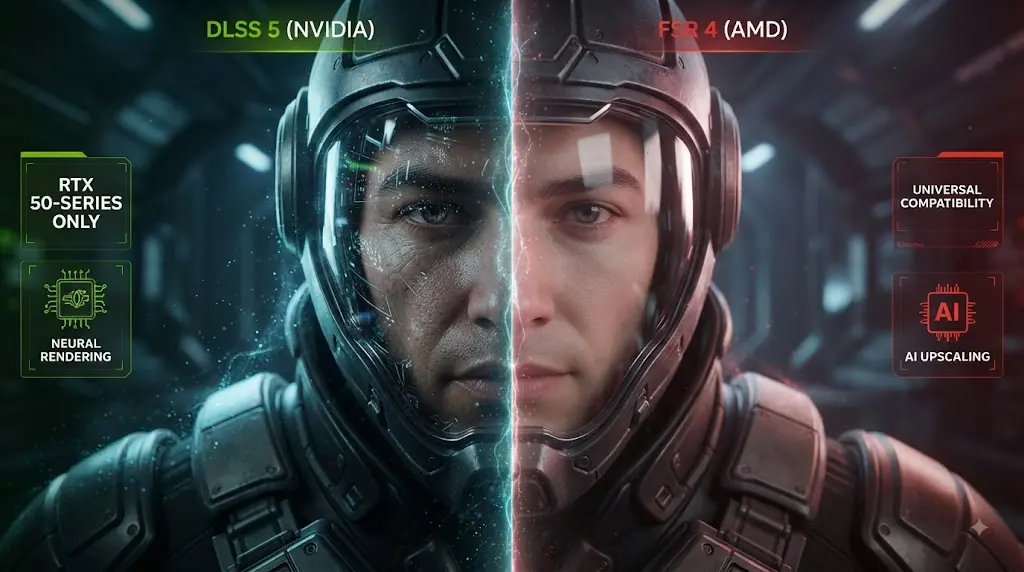
Upscaling has basically become the deciding factor in how modern games run, and right now there are two names dominating the conversation: NVIDIA’s DLSS 5 and AMD’s FSR 4. They’re chasing different goals, though. NVIDIA is going all-in on image quality for people with top-tier hardware, while AMD is betting on getting good results on whatever GPU you happen to own.
So which one should you actually care about? That depends a lot on what’s in your PC right now — and whether an upgrade is even on the table. Here’s how they stack up.
Quick Comparison
| Feature | DLSS 5 (NVIDIA) | FSR 4 (AMD) |
|---|---|---|
| Developer | NVIDIA | AMD |
| Main strength | Visual fidelity, neural rendering | Works everywhere, solid performance |
| GPU support | RTX 50-series only (for now) | AMD, NVIDIA, and Intel cards |
| Core tech | Neural rendering + AI lighting | AI upscaling + ML frame generation |
| Image quality | Excellent — strong lighting and material detail | Good, a bit softer than DLSS 5 |
| Frame generation | Neural-based, more advanced | ML-based, lighter on resources |
| Best for | RTX owners chasing top-end visuals | Everyone else, basically |
Image Quality: DLSS 5 Still Has the Edge
There’s not much debate here — DLSS 5 looks better. It’s not simply upscaling a lower-res image anymore; the neural rendering model is actively reworking lighting, shadows, reflections, and surface detail as it goes. Boot up something like Starfield or Resident Evil Requiem and you’ll notice it almost immediately in the way skin and hair render, or how light bounces around a room.
FSR 4 has closed the gap considerably compared to earlier versions — it’s sharper, more stable, and handles motion pretty well. But look closely at complex scenes or fine detail and it still comes across a touch softer than what NVIDIA is doing. It’s good. It’s just not quite there yet.
Winner: DLSS 5, for raw image quality.
Performance: It Really Comes Down to Your Card
Neither of these is slow, but where you land depends heavily on what hardware you’re running.
On RTX 50-series cards, DLSS 5 tends to hold onto high frame rates without sacrificing much visually. Meanwhile, on AMD Radeon and mid-range GPUs, FSR 4 often pulls ahead on raw FPS thanks to its lower overhead.
At 4K with ray tracing cranked up, DLSS 5 generally feels smoother and more consistent. Drop down to 1440p or a competitive setup, though, and FSR 4 can actually edge it out on non-NVIDIA hardware simply because it demands less from the system.
Winner: Depends entirely on your GPU — DLSS 5 if you’re on high-end NVIDIA, FSR 4 for AMD or a mixed rig.
GPU Compatibility: The Real Dealbreaker for Most People
This is honestly where the decision gets made for a lot of gamers. DLSS 5 is locked to RTX 50-series cards right now, full stop. FSR 4, on the other hand, runs on Radeon, GeForce, and even Intel Arc GPUs. If you’re not sitting on the latest NVIDIA silicon, FSR 4 is really your only option — which also makes it the more practical pick for most people reading this.
Want the deeper dive on why DLSS 5 is so hardware-restrictive? Check out our guide on what DLSS 5 actually is.
Games That Support Both
A handful of major titles now let you flip between DLSS 5 and FSR 4 directly, which makes for an easy side-by-side test. Starfield, Resident Evil Requiem, Assassin’s Creed Shadows, Hogwarts Legacy, and NARAKA: BLADEPOINT all support both. If you’ve got access to either technology, these are the games to try it in yourself rather than take our word for it.
For the full rundown of supported titles, see our DLSS 5 supported games list.
So, Which Should You Pick?
Honestly, it mostly comes down to what card you own:
- Got an RTX 50-series card? Go with DLSS 5 — the visuals and integration are worth it.
- Running AMD Radeon? FSR 4 is the obvious call for both performance and compatibility.
- Stuck with older or mismatched hardware? FSR 4 is your best bet for now.
- Care mostly about visuals at 4K? DLSS 5 will impress you more.
- Playing competitively? Worth testing both, but FSR 4 tends to run with lower latency on non-RTX setups.
Curious about the release timeline? We’ve got a DLSS 5 release date guide, and if you want to see how the neural rendering compares to traditional ray tracing, there’s a full breakdown here.
Final Verdict
DLSS 5 is the more technically impressive of the two right now — nothing else touches it on lighting and material detail. But FSR 4 is the more sensible choice for the majority of gamers simply because it works on almost anything. Neither one is “better” in a vacuum; it really just comes down to which GPU is sitting in your PC.
We’ll keep updating this comparison as both technologies continue evolving through 2026.
Frequently Asked Questions
It depends on your GPU. DLSS 5 wins on image quality, while FSR 4 wins on accessibility.
Yes, it works well on NVIDIA cards too.
FSR 4 often gives higher FPS on AMD and mid-range hardware. DLSS 5 performs better on high-end RTX cards with superior visuals.
DLSS 5 is generally ahead, especially in lighting and material detail.
Try both in games that support them. Most RTX users prefer DLSS 5, while AMD users stick with FSR 4.