
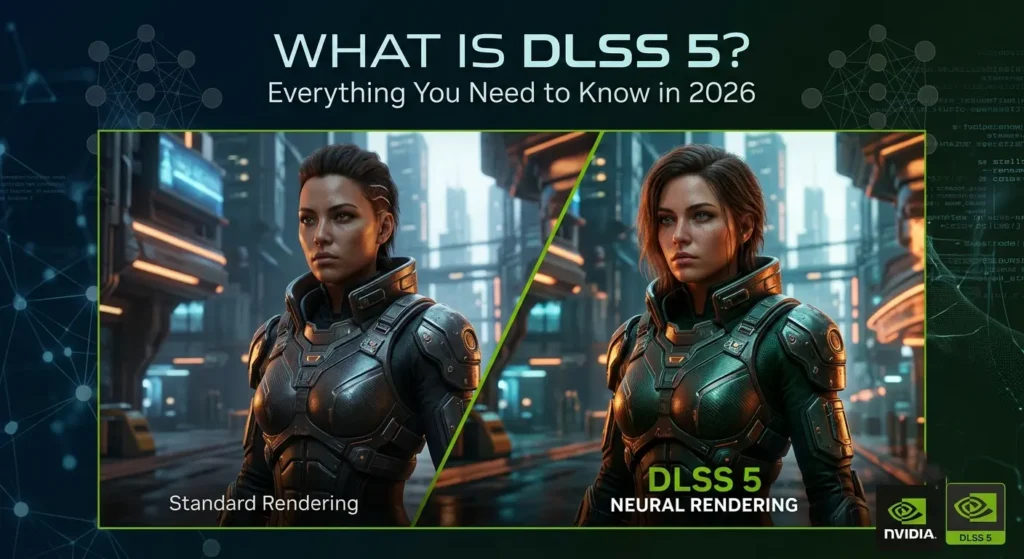
Imagine booting up your favorite game and noticing skin that catches light more naturally, hair with realistic shine, and environments that feel more grounded and alive — all running smoothly in real time. That’s the pitch behind DLSS 5, NVIDIA’s most ambitious graphics update since real-time ray tracing.
Unveiled at GTC 2026, DLSS 5 shifts the focus of the DLSS family. Earlier versions were mainly about higher frame rates through upscaling and frame generation. This one emphasizes photorealistic lighting and materials powered by real-time neural rendering. This guide breaks down what DLSS 5 actually is, how it works, which GPUs support it, and whether it’s worth waiting for.
What Is DLSS 5?
DLSS 5 stands for Deep Learning Super Sampling 5. It’s NVIDIA’s latest AI-powered graphics technology. At its core, it uses a real-time neural rendering model that upgrades game frames with much more realistic lighting, reflections, shadows, and material details.
Unlike earlier DLSS versions that mostly focused on boosting frame rates, DLSS 5 puts visual quality first. It starts with a normally rendered frame from the game engine and then uses AI to add effects that would normally demand a lot more rendering power. NVIDIA is marketing it as a big step toward bridging the gap between real-time gaming graphics and Hollywood-level cinematic visuals.
Announced in mid-March 2026 at GTC, DLSS 5 is scheduled to launch properly in Fall 2026. It will initially work on RTX 50-series GPUs, with support already confirmed from major publishers like Bethesda, CAPCOM, Ubisoft, Tencent, and Warner Bros. Games.
Most importantly, DLSS 5 is not just another post-processing filter. It takes the game’s color data and motion vectors to make sure the enhancements stay grounded in the actual 3D world of the game.
How Does DLSS 5 Work?
Here’s the simple version: The game engine renders its normal frame with geometry, textures, and initial lighting. DLSS 5 then analyzes that output along with motion data and runs it through an AI model trained to recognize and improve elements like skin, hair, fabric, and different lighting conditions.
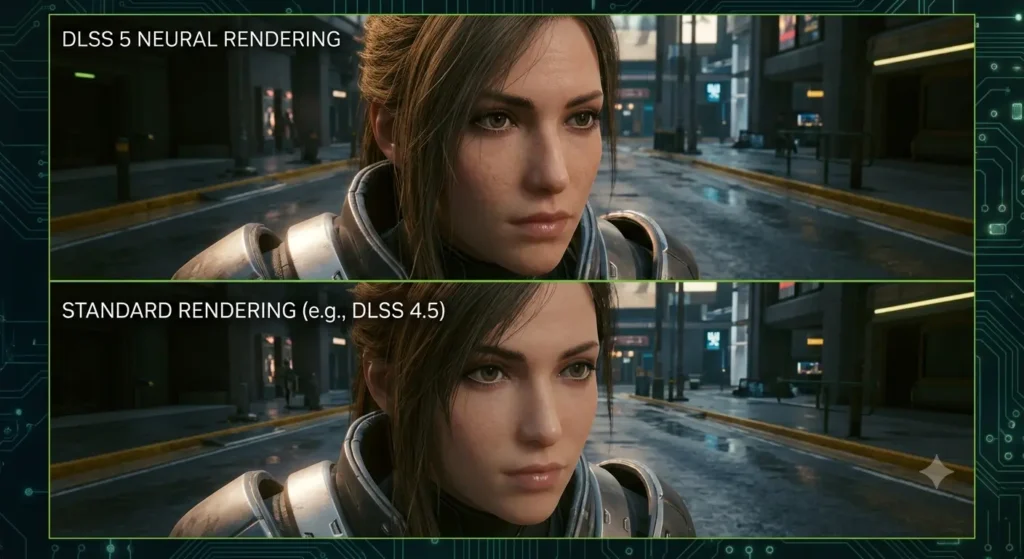
The result includes enhanced global illumination, more believable subsurface scattering on characters, natural light interaction with hair, and richer material responses.
Technical sessions at SIGGRAPH 2026 provided more detail on the architecture. NVIDIA has emphasized developer controls to help studios preserve each game’s intended art direction.
The technology integrates through NVIDIA’s existing Streamline framework.
Key Features of DLSS 5
- Neural rendering for photorealism — Adds advanced lighting and material effects in real time.
- Scene-aware processing — Adjusts based on surface types and lighting conditions.
- Developer controls — Intensity and masking options to protect artistic intent.
- Temporal stability — Consistent frame-to-frame with reduced shimmer.
- 4K-focused performance — Designed for smooth high-resolution gameplay.
- Broad pipeline integration — Works with rasterized, ray-traced, and path-traced rendering.
DLSS 5 vs DLSS 4: What’s Actually Different
| Feature | DLSS 4 / 4.5 | DLSS 5 |
|---|---|---|
| Primary Goal | Performance (upscaling + frame gen) | Visual fidelity (neural rendering) |
| Core Technology | Transformer upscaling + Multi Frame Gen | Real-time neural rendering + lighting/materials |
| GPU Support | RTX 20-series and up | RTX 50-series at launch |
| FPS Impact | Significant boost | Neutral to minor |
| Availability | Available now | Fall 2026 |
The two technologies are designed to complement each other. In supported titles, you may use DLSS 4 tools for performance and DLSS 5 for the visual layer on top.
Which GPUs Support DLSS 5?
DLSS 5 launches exclusively on RTX 50-series GPUs. Support for RTX 40-series or older cards has not been confirmed yet.
Benefits of DLSS 5
The biggest draw is real-time visuals that feel closer to offline cinematic quality — richer lighting, more convincing characters, and materials that react naturally to the environment.
Limitations of DLSS 5
- Hardware exclusivity at launch (RTX 50-series only)
- Mixed early reception and concerns about artistic changes
- Limited initial game support
- Focus on quality rather than raw FPS gains
Should You Use DLSS 5?
If you own or plan to upgrade to an RTX 50-series card, DLSS 5 is worth testing once it arrives — particularly in story-driven or visually rich games.
If you’re interested in when it launches, check our detailed DLSS 5 Release Date guide.
Frequently Asked Questions
Yes. It will be available at no extra cost through GeForce drivers for supported games.
Not confirmed for the initial Fall 2026 launch.
In terms of lighting, material detail, and realism, early demos suggest it can be in many scenes — though final results will depend on each game’s implementation.
Confirmed or announced early support includes Starfield, Resident Evil Requiem, Assassin’s Creed Shadows, and Hogwarts Legacy, among others from publishers like Bethesda, CAPCOM, and Ubisoft. More titles will be added after launch.
NVIDIA has confirmed a Fall 2026 window. For the latest details, see our DLSS 5 Release Date guide.