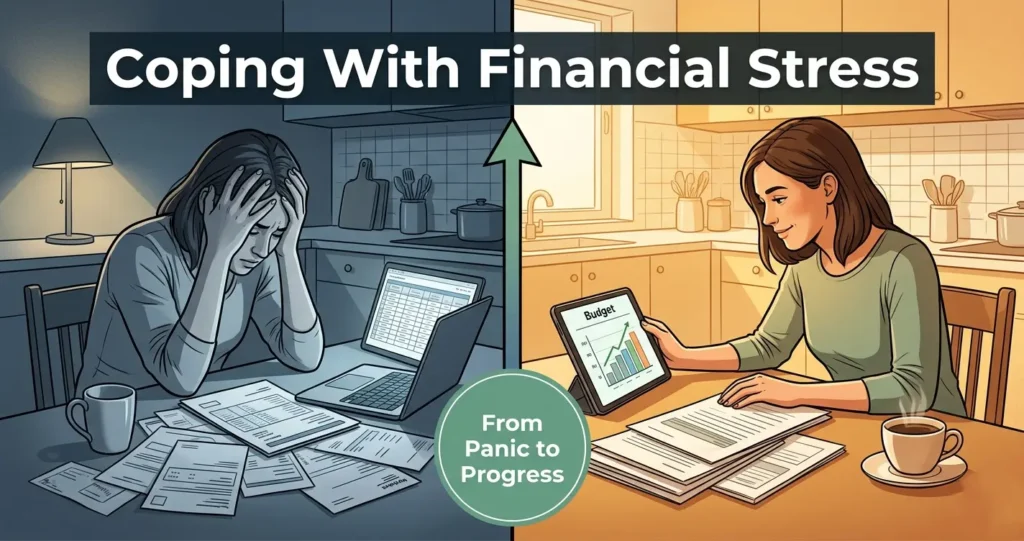
Your heart races when your phone buzzes. Another notification. Probably a bill. You’ve stopped checking your bank account because seeing the numbers makes your chest tight.
Financial stress isn’t just about money. It’s waking up at 3 AM calculating which bill you can skip this month. It’s avoiding your partner’s texts because you know they want to “talk about money.” It’s the headache that won’t go away and the stomach knot that lives there now.
I’m not going to tell you to “just make a budget.” You already know that. What you need is a system for coping with financial stress when your brain is too fried to think straight.
Stop Doing These Things (They Make It Worse)
Ignoring All Your Financial Accounts
Why it backfires: The unknown is always scarier than reality
I avoided my credit card statements for four months in 2019. When I finally looked, the situation was bad—but not as catastrophic as my brain had convinced me it was. The horror movie in my head was worse than the actual balance.
Do this instead: Set a 10-minute timer. Open one account. Write down the balance. Close it. That’s it for today. Tomorrow, open a different one.
Making Financial Decisions at 2 AM
Rating: Panic-Driven Disaster – 2/10
✅ PRO: None. Absolutely zero benefits
❌ CON: You will regret every choice made during an anxiety spiral
Midnight is when payday loans look reasonable. When cashing out your 401(k) seems smart. When texting your ex about “borrowing” money feels acceptable.
Financial stress triggers your fight-or-flight response. Your prefrontal cortex—the part that makes rational decisions—goes offline. Anything decided during a panic attack should be revisited in daylight.
Isolating Yourself Completely
The trap: Shame makes you hide
Financial problems feel uniquely personal. Like everyone else has it figured out and you’re the only one drowning. According to a 2024 American Psychological Association study, 72% of Americans report feeling stressed about money—but 68% never talk about it.
You’re not alone. You just feel alone because nobody discusses it.
The Emergency Triage System (For When You’re Drowning)
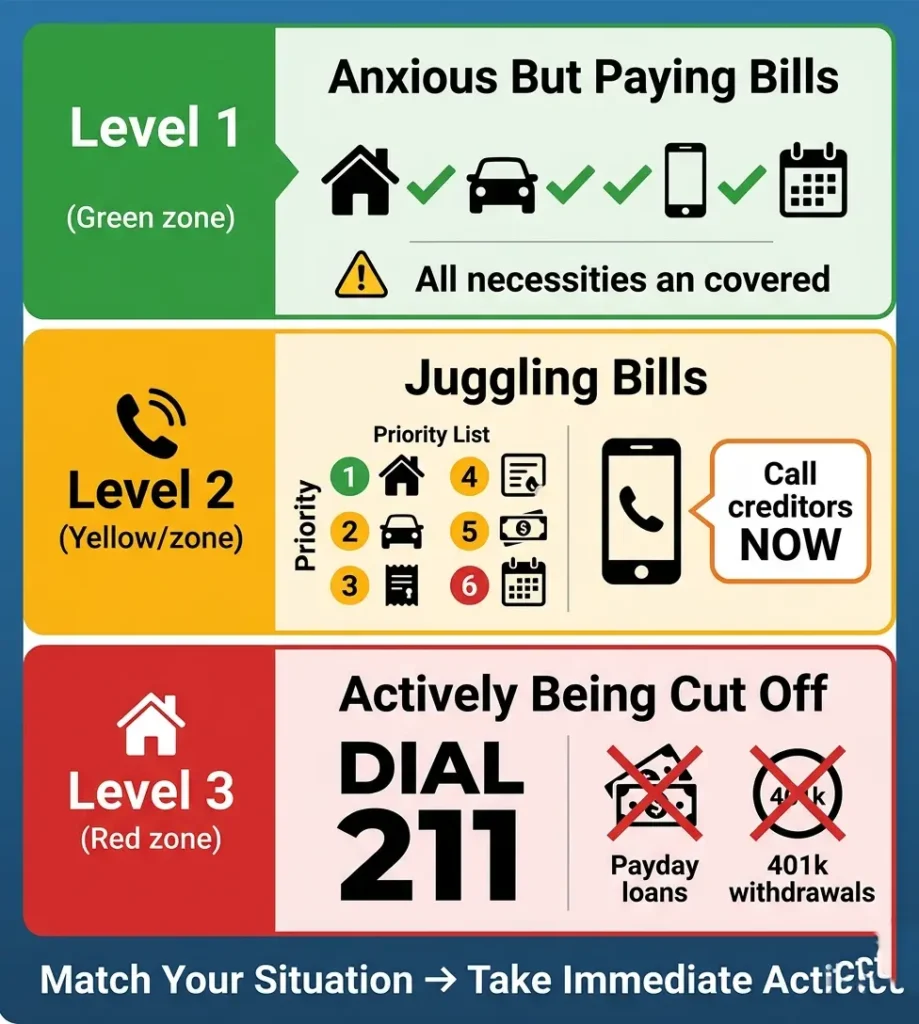
Coping with financial stress requires different strategies depending on your crisis level. Here’s how to categorize your situation:
Level 1: “I’m Anxious But Paying Bills”
- All necessities covered (rent, utilities, minimum payments)
- Stress is about the future, not immediate survival
- You have some savings, even if small
Action: Skip to the “Building Resilience” section below
Level 2: “I’m Juggling Which Bill to Pay”
Rating: High-Risk Zone – Immediate Action Required
✅ PRO: You recognize the problem before total collapse
❌ CON: This is the stage where people make irreversible mistakes
You’re playing bill roulette. Power or water? Credit card or car payment? This is where financial stress becomes dangerous.
Immediate priorities (in this exact order):
- Housing (rent/mortgage) – eviction takes months to recover from
- Utilities – especially heat in winter, AC in extreme heat
- Food – not restaurants, actual groceries
- Transportation needed for work
- Minimum debt payments (NOT full balances)
- Everything else waits
Call your creditors before you miss payments. Most have hardship programs. The script: “I’m experiencing financial hardship and need to discuss my options.” Don’t over-explain. Don’t apologize excessively.
Level 3: “I’m Actively Being Cut Off”
- Shut-off notices arrived
- Eviction warning received
- Repo threats for your car
- Collections agencies calling
Do NOT:
- Take out payday loans (400% APR will destroy you)
- Use credit cards for bills (you’re just moving the problem)
- Cash out retirement accounts (penalties + taxes = losing 40%)
Do this TODAY: Contact 211 (dial 2-1-1 from any phone in the US). Free referrals to:
- Emergency rent assistance
- Utility payment programs
- Food banks
- Legal aid for eviction defense
Real talk: I used a food bank in 2020. The shame nearly stopped me from going. But free groceries meant I could pay rent. Pride is expensive.
The Psychological Symptoms Nobody Warns You About
Financial stress manifests physically. If you’re experiencing these, you’re not “crazy” or “weak”:
Insomnia or Revenge Bedtime Procrastination
You’re exhausted but can’t sleep. Or you stay up late because it’s the only time that feels like “yours” even though you’re just doom-scrolling.
Why it happens: Your body is stuck in threat-detection mode. Your amygdala thinks a predator is nearby (it’s your Discover card statement, but your brain doesn’t know that).
Helps: Write your anxious thoughts in a notebook before bed. Not solutions. Just the thoughts. “I’m worried about the electric bill. I don’t know how to fix the car.” Your brain will quiet down once it knows you’ve “recorded” the worries.
Decision Paralysis on Tiny Choices
Can’t decide which brand of cereal to buy. Stand in the grocery aisle for 15 minutes comparing prices on pasta.
Why it happens: Decision fatigue. You’ve already made 50 stress-calculations today (Can I afford gas to visit my friend? Should I skip lunch to save $8?). Your brain has no bandwidth left.
Helps: Automate everything possible. Same breakfast every day. Pre-plan dinners. Eliminate micro-decisions.
Rage at Small Inconveniences
Your partner loads the dishwasher “wrong” and you want to scream. Someone’s car alarm goes off and you fantasize about destroying it.
Why it happens: Chronic stress = chronic cortisol = hair-trigger irritability.
Helps: Not much fixes this while you’re in crisis. But knowing why you’re snapping at everyone helps prevent relationship damage. Tell your people: “I’m not angry at you, I’m angry at the situation.”
The Honest Budget (That Actually Works Under Stress)
Forget the 50/30/20 Rule
Skip It – Useless During Crisis
That rule is for people with stable incomes and manageable debt. You’re triaging. Different rules apply.
The survival budget:
- List every dollar coming in
- List survival expenses (housing, food, utilities, transportation)
- Subtract survival from income
- Whatever’s left = debt payments
If there’s nothing left? You’re in Level 3 crisis (see above). You need intervention, not budgeting.
The “$10 Decision Rule”
Rating: 8/10 for Reducing Decision Fatigue
✅ PRO: Eliminates 90% of spending guilt
❌ CON: Requires one-time setup effort
Any purchase under $10: don’t overthink it. Yes, technically you could save that $7 on coffee. But the mental energy spent agonizing over small purchases creates more stress than the savings provide.
Purchases over $10: 24-hour rule. Add to cart, revisit tomorrow.
Purchases over $100: 72-hour rule + discuss with someone.
This isn’t “financial irresponsibility.” It’s preserving your decision-making energy for choices that matter.
What’s Worth Skipping (Unpopular Opinions)
Credit Counseling Services
Maybe Skip – 6/10
These are legitimate businesses, but many just negotiate payment plans you could arrange yourself with a phone call. They charge fees (often $30-50/month) for something you can DIY.
When they’re worth it: You have 5+ creditors and the overwhelm is preventing you from calling anyone. Paying someone to coordinate might be worth the fee.
Dave Ramsey’s Debt Snowball
Skip During Crisis – 4/10
Ramsey’s advice is excellent for people with stable incomes working toward debt freedom. But if you’re in survival mode, his “smallest balance first” approach might mean ignoring your highest-interest debt while it compounds.
Do this instead: Pay minimums on everything. Put any extra toward the highest interest rate. Math beats motivation when you’re drowning.
Extreme Frugality Challenges
Actively Harmful – 2/10
“No-spend month” challenges, eating rice and beans exclusively, eliminating all “luxuries” including toilet paper quality.
Why it backfires: Creates deprivation so extreme you’ll binge-spend later. Financial stress requires sustainable changes, not punishment.
I tried the “absolute bare minimum” approach in 2019. Lasted six weeks before I spent $200 on takeout in a single weekend because I was so resentful of eating oatmeal for the 40th consecutive breakfast.
Building Actual Financial Resilience
The $500 Emergency Fund
Priority #1 After Stopping the Bleeding
Not $1,000. Not six months of expenses. Just $500 sitting in a savings account you never touch unless the car breaks or the dog needs the vet.
Why $500 specifically: It covers 80% of surprise expenses without being so large it feels impossible to save.
How to get there: Automate $25/paycheck if you’re paid biweekly. You’ll hit $500 in 10 months. Can’t spare $25? Start with $10. Forward motion matters more than speed.
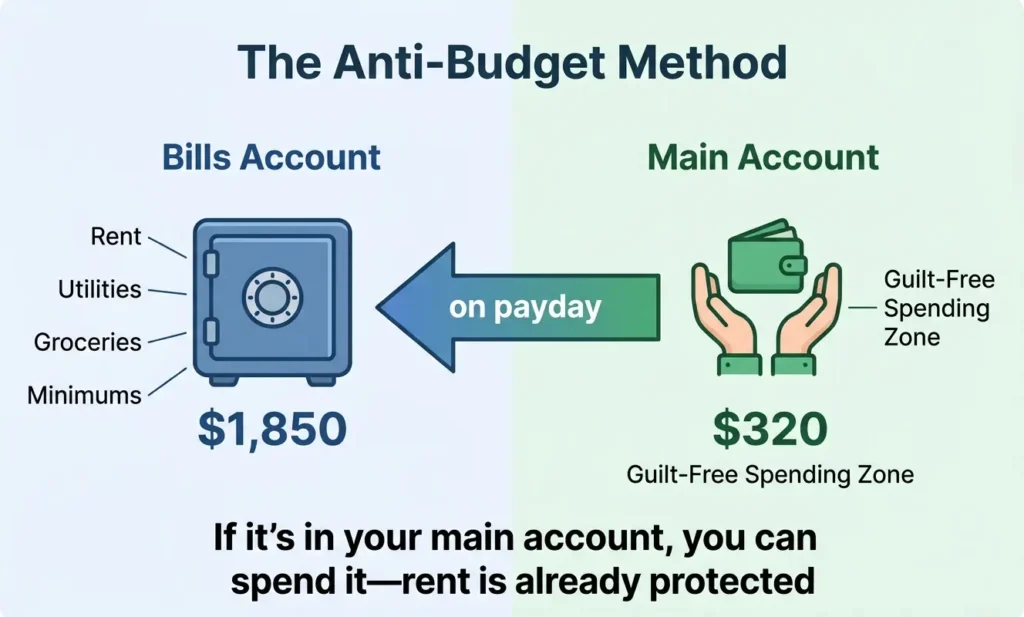
The “Anti-Budget” Method
Rating: 9/10 for Stress Reduction
✅ PRO: No spreadsheets, no daily tracking, actually sustainable
❌ CON: Requires consistent income (doesn’t work for variable freelance pay)
- Calculate your monthly survival expenses (rent, utilities, groceries, minimums)
- Set up auto-transfers on payday to move that exact amount to a separate “bills” checking account
- Whatever’s in your main account = spendable money
You can’t accidentally spend rent money if it’s physically not available.
Income Increase > Expense Cutting
The math that changed my perspective:
You can cut expenses to zero. There’s a hard limit. But income? No ceiling.
I spent two years micromanaging grocery spending, trying to shave $20/month off my food budget. Then I asked for a raise at work ($3,000 more per year) and picked up one freelance client ($400/month). In three months, I increased my income more than two years of extreme couponing achieved.
Not saying “just make more money” (I know how dismissive that sounds). But if you’re spending 10 hours/week optimizing spending, consider redirecting 5 of those hours toward income opportunities.
The Relationship Conversation (When Money Stress Affects Your Partner)
Why Couples Fight About Money
It’s never actually about the money. It’s about:
- Control (who decides what gets spent)
- Values (what’s “worth it” to spend on)
- Fear (what financial disaster are we avoiding)
- Shame (who’s “responsible” for the situation)
My partner and I almost ended over a $200 emergency car repair in 2021. Not because we didn’t have $200. Because I was ashamed I hadn’t “saved enough” and they were frustrated I was “overreacting.”
The Money Meeting Format That Doesn’t End in Fighting
Time: Sunday morning, 20 minutes MAX
Location: Kitchen table (not bedroom—money fights should stay out of intimate spaces)
Rules:
- Each person gets 5 uninterrupted minutes to voice concerns
- No solutions yet—just listening
- After both people speak, identify ONE action item for the week
- End with something positive (even if it’s just “we showed up for this conversation”)
Sample action items:
- “Call the credit card company about a payment plan”
- “Research which subscription we’re willing to cancel”
- “Sign up for the 211 resource list”
ONE action. Not 47. Progress over perfection.
When to Get Professional Help
You need therapy (not just financial advice) if:
- You’re having panic attacks when checking your bank account
- You’re avoiding all financial tasks for weeks at a time
- Your relationship is fracturing over money fights
- You’re experiencing suicidal thoughts related to debt
Cost barrier: Many therapists offer sliding scale fees. Open Path Collective charges $30-80/session. Some offer financial-stress-specific counseling.
This isn’t “treating yourself to therapy.” This is treating the mental health crisis that happens to have a financial trigger.
The Uncomfortable Truth About Financial Recovery
It’s slow. Agonizingly slow.
You didn’t accumulate this stress overnight. You won’t resolve it in a weekend budgeting binge. If you’re $15,000 in credit card debt, paying minimums means years of payments.
That timeline will make you want to quit. You’ll think “what’s the point of paying $200/month when I still owe $14,800?”
The point is that $14,800 is less than $15,000. The point is that continuing to make payments means you’re not adding new debt. The point is that financial stress decreases before the debt is gone—once you have a plan and you’re following it, the anxiety reduces even though the balance hasn’t.
Free Resources That Actually Help
211 (Dial 2-1-1)
Connects you to local emergency assistance—rent help, food banks, utility programs. Available in all 50 states.
National Foundation for Credit Counseling (NFCC.org)
Free or low-cost counseling. Legitimate—check their accreditation.
Benefits Checkup (BenefitsCheckup.org)
Find government programs you might qualify for. Many people leave money on the table because they don’t know these programs exist.
r/povertyfinance (Reddit)
Surprisingly supportive community. People share what actually worked (and what failed spectacularly). Less judgment than you’d expect.
Small Wins to Celebrate (Yes, Really)
- You opened your bank account today
- You made one phone call to one creditor
- You didn’t take out a payday loan when desperate
- You had the money conversation with your partner without screaming
- You asked for help
These aren’t “participation trophies.” When you’re coping with financial stress, showing up is the victory. Neuroscience backs this: celebrating small progress releases dopamine, which combats the cortisol flood stress creates.
Final Word: Coping with financial stress isn’t about becoming perfect with money. It’s about not letting the anxiety destroy your health, relationships, and ability to function. You’re not failing at adulthood. You’re navigating a legitimately difficult situation. Small steps count.
FAQs About Coping With Financial Stress
Controlled breathing (4-7-8 technique: inhale 4 counts, hold 7, exhale 8) interrupts the panic cycle. For recurring money-triggered panic attacks, see a therapist—this is treatable anxiety, not a character flaw.
Only if asking about paycheck advances, hardship withdrawals from 401(k), or employee assistance programs (EAPs). Don’t overshare details—keep it factual: “I’m exploring available financial resources.”
It’s a tool, not a moral failing. Chapter 7 stays on your credit for 10 years but stops collections immediately. Consult a bankruptcy attorney (many offer free consultations) before deciding. Sometimes it’s the right answer.
Most people report reduced anxiety within 4-6 weeks of having a written plan—even if the debt hasn’t decreased yet. The stress comes from uncertainty, not the balance itself.
Open Path Collective ($30-80/session), community mental health centers (sliding scale), or text HOME to 741741 for free crisis counseling. Financial stress is a legitimate mental health crisis.
Start with “I’m feeling anxious about our finances and I need to talk about it for my mental health.” Frame it as your need, not their failure. If they still refuse, couples counseling addresses the communication breakdown, not just the money.