For years, buying an Xbox meant making a fairly simple decision. You chose a console, bought your games through the Xbox ecosystem, and played them without worrying too much about what was happening underneath the hardware.
Microsoft now seems ready to change that relationship.
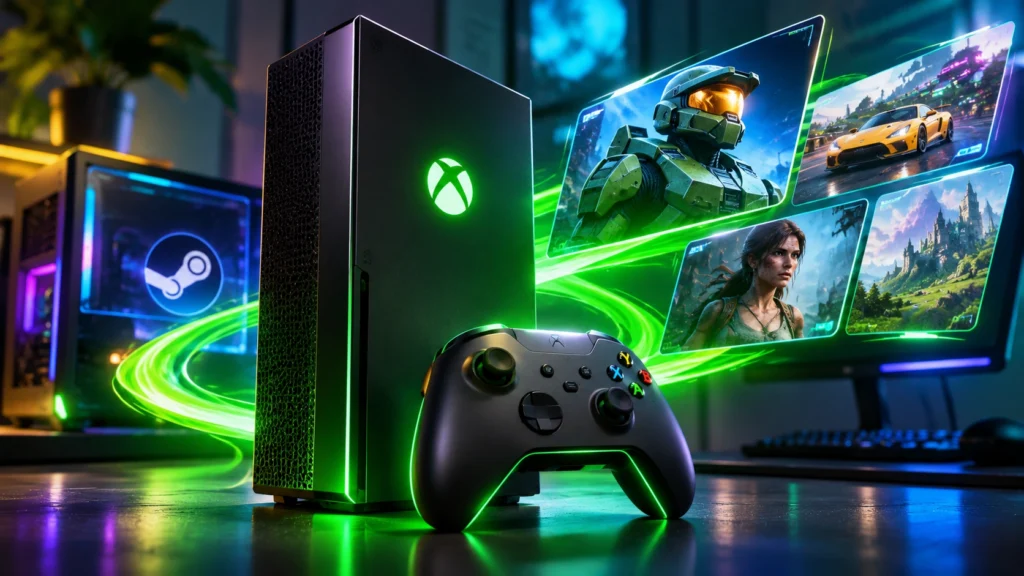
Its upcoming console, Project Helix, is being developed with a rather different ambition. Instead of focusing exclusively on traditional console gaming, Microsoft wants its next Xbox to run both Xbox console games and PC games. That could make it one of the most interesting hardware launches in the company’s history.
The announcement has already raised plenty of questions. Will it be powerful enough to compete with high-end gaming PCs? Could it run Steam games? What kind of AMD processor will Microsoft use? And perhaps the biggest question for existing owners: is there any reason to upgrade from an Xbox Series X?
We have some answers, but not nearly as many as hardware enthusiasts would like.
Microsoft confirmed Project Helix at the Game Developers Conference in March 2026. Since then, the company has shared more about its approach to graphics, backward compatibility and the relationship between console and PC gaming. Its November anniversary updates have also given us a better idea of where the project is heading.
Let’s look at what is actually known, what remains uncertain, and why some of these changes could matter more than another increase in graphics performance.
Next Xbox Specs: What Do We Know So Far?
Before getting into the technical details, there is one thing worth clearing up: Project Helix is still under development. Microsoft has not published a complete retail hardware specification sheet.
We know the processor will be a custom AMD SoC, and the platform is being designed around next-generation DirectX and FSR technology. Beyond that, several important details are still missing.
Here is the current picture.
| Specification | Project Helix |
|---|---|
| Project name | Project Helix |
| Processor | Custom AMD SoC |
| CPU architecture | Not announced |
| CPU cores | Not announced |
| GPU | Custom AMD graphics technology |
| GPU architecture | Not announced |
| Ray tracing | Major generational improvement targeted |
| Upscaling | Next-generation FSR |
| DirectX | Next-generation DirectX |
| AI processing | Intelligence integrated into graphics and compute pipeline |
| Game compatibility | Xbox console and PC games |
| Backward compatibility | Four Xbox generations |
| Developer hardware | Alpha versions planned for 2027 |
| RAM | Not announced |
| Storage | Not announced |
| Resolution target | Not announced |
| Frame-rate target | Not announced |
| Retail price | Not announced |
| Consumer launch date | Not announced |
Notice how many specifications are still missing. There is no confirmed GPU compute-unit count, CPU clock speed or memory bandwidth. If you encounter a website publishing exact Project Helix hardware numbers, check whether those figures come from Microsoft or are simply somebody’s prediction.
I would rather see an honest specification table than one filled with numbers that might turn out to be completely wrong.
Why Microsoft Is Working With AMD on Project Helix
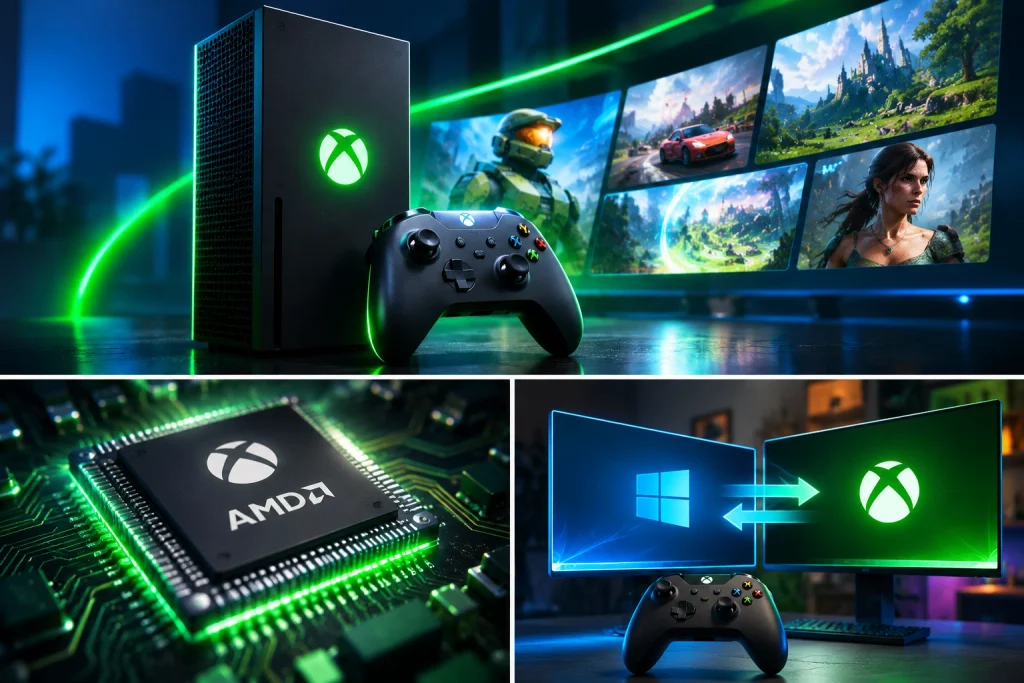
The AMD partnership is not new. AMD has already supplied custom processors for Xbox Series X and Series S, so continuing that relationship makes sense.
The difference is what Microsoft wants to achieve this time.
Project Helix will use a custom system-on-chip, or SoC. Rather than treating the processor and graphics hardware as separate off-the-shelf components, this approach allows Microsoft and AMD to develop an integrated platform around the needs of the console.
That matters when games become more demanding.
A modern open-world game might be processing hundreds of characters, environmental effects, physics calculations and background activities while simultaneously rendering a detailed environment. The GPU handles much of the visual work, but the CPU has to keep the game world functioning.
Simply increasing graphics power will not solve every performance limitation.
Microsoft has specifically mentioned rendering and simulation as major areas of development for Project Helix. The company is also working on improvements in efficiency, which will be important as developers try to build increasingly complex games.
We will need to see the final chip before judging AMD’s contribution, but the direction is clear: Microsoft wants to improve more than just the graphics pipeline.
Next Xbox CPU: Will Project Helix Deliver Better Gaming Performance?
There is very little confirmed information about the next Xbox CPU.
Microsoft has not revealed its architecture, number of cores, clock speeds or cache configuration. AMD has also not published a complete processor specification for the retail console.
Still, there is a good reason to pay attention to the CPU.
Think about games such as Microsoft Flight Simulator or large open-world titles. Rendering detailed buildings and landscapes is only one part of the job. The game also needs to manage traffic, weather, physics, NPC behaviour and countless background calculations.
When the CPU cannot process these tasks quickly enough, performance can suffer even when the GPU has some room left.
This is one reason why powerful graphics hardware does not automatically guarantee high frame rates.
A stronger CPU could give developers more freedom to create busier environments, improve simulation systems and maintain smoother performance in demanding games. It could also help when running PC games, which may have different CPU requirements from games developed specifically for Xbox.
There is no point guessing the exact core count yet. What I will be watching is how Microsoft balances CPU performance, power consumption and compatibility with existing game development tools.
Next Xbox GPU and Ray Tracing: What Could Actually Improve?
Microsoft has made a particularly ambitious statement about Project Helix’s ray-tracing capabilities.
According to Jason Ronald, Xbox’s VP of Next Generation, the system is targeting an order-of-magnitude improvement in ray-tracing performance and capability.
That sounds enormous, but it is important not to interpret it as a tenfold improvement in overall console performance.
Ray tracing is one specific area of graphics processing.
For anyone unfamiliar with the technology, it is used to simulate how light interacts with objects in a virtual environment. Depending on the implementation, it can produce more realistic reflections, shadows and lighting.
You can see why developers want it. A reflection in a shop window, light bouncing around an indoor environment or sunlight passing through different objects can make a game world feel considerably more convincing.
The problem is performance.
These effects can consume a significant amount of GPU resources. On current-generation hardware, developers often have to decide where ray tracing is worth using and where traditional rendering techniques make more sense.
Project Helix could give them more flexibility.
For example, a developer might be able to use more advanced lighting across a larger part of a game rather than limiting expensive effects to selected areas.
But there is a difference between hardware capability and what developers actually implement. Even if Microsoft achieves its target, individual games will still make different decisions about graphics quality and performance.
The final result will depend on the complete hardware and how well studios use it.
FSR Next: Why Upscaling Will Matter on the Next Xbox
There is another piece of the graphics puzzle that deserves attention: AMD’s FidelityFX Super Resolution technology, or FSR.
Upscaling has become increasingly important in modern gaming because rendering a game at a high native resolution can be extremely demanding.
FSR works by reconstructing a higher-resolution output from a lower-resolution internal image. This can reduce the amount of rendering work required from the GPU.
For example, a game might render internally at a resolution below 4K and reconstruct the final image for a 4K display.
The saved GPU resources can then be used elsewhere, depending on the game’s implementation.
Developers might spend that additional performance budget on better lighting, more detailed environments or higher frame rates.
However, upscaling is not a magic solution. Image reconstruction quality matters. Poor implementations can produce visual artefacts, shimmering and ghosting, particularly around fast-moving objects.
Microsoft has also started bringing newer FSR technology to its existing ecosystem. On November 4, 2026, Microsoft announced FSR Upscaling 4 availability for Xbox developers.
That announcement concerns supported current-generation development hardware; it should not be confused with a complete Project Helix specification.
For the next Xbox, Microsoft has confirmed that the hardware is being co-designed around next-generation DirectX and FSR.
How well the technology performs in actual games will be much more interesting than its marketing description.
Will the Next Xbox Run Games at 4K 120 FPS?
If you have been following next-generation console rumours, you have probably seen plenty of claims about 4K gaming at 120 FPS.
Unfortunately, Microsoft has not confirmed a specific resolution or frame-rate target for Project Helix.
And even if the hardware eventually supports 4K at 120 FPS in certain games, expecting every title to deliver that performance would be unrealistic.
Consider the difference between a competitive shooter and a cinematic open-world game.
A competitive shooter may prioritize responsiveness and high frame rates. An ambitious open-world game could use considerably more resources for lighting, physics, detailed environments and character animation.
Both games have different priorities.
A higher-performance console should give developers more room to balance these requirements, but the final settings will remain a game-by-game decision.
I would also like to see Microsoft explain how its next-generation hardware handles demanding games with ray tracing enabled. A high frame rate without advanced graphics is one thing; maintaining good performance while using demanding visual effects is another.
Until retail hardware and real gameplay benchmarks are available, exact 4K and 120 FPS claims remain speculation.
Project Helix Could Be More Interesting Than a Traditional Gaming PC
This is probably the biggest reason to follow Microsoft’s next Xbox plans.
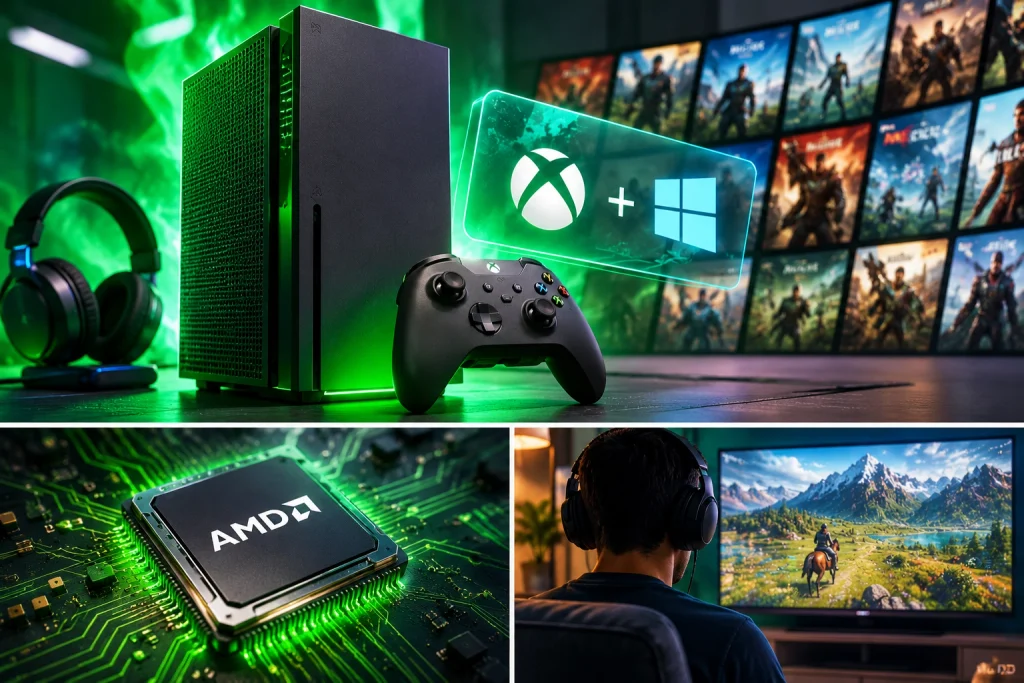
Microsoft has confirmed that Project Helix is designed to play both Xbox console games and PC games. However, the company has been careful about how it describes the experience.
In an interview published around Xbox’s 25th anniversary on November 15, Jason Ronald explained that the goal is to build a console capable of playing PC games, rather than simply creating a PC that can run console games.
That distinction tells us quite a lot about Microsoft’s thinking.
PC gaming offers enormous flexibility. You can adjust graphics settings, choose different hardware, install software and access different game storefronts. But that flexibility also comes with occasional headaches.
A driver update, shader compilation issue or unexpected compatibility problem can turn a planned gaming session into a troubleshooting exercise.
Console owners generally buy an Xbox because they don’t want to deal with all that.
They want to turn on the system, pick a game and start playing.
Microsoft will need to preserve that experience if it expects traditional console buyers to embrace Project Helix. If the interface feels like a desktop operating system that happens to run games, it could lose much of the appeal that made Xbox popular in the first place.
The company has not yet revealed exactly how PC games will be accessed, which storefronts will be supported or whether users will have complete control over the operating system.
Steam support, in particular, should not be treated as confirmed.
There is a big difference between saying a device can play PC games and confirming that every PC storefront and game will work on it.
What Happens to Existing Xbox Games?
For anyone who has spent years building an Xbox library, backward compatibility is not a small feature.
You might own dozens of digital games, have achievements tied to older titles or still enjoy games from the Xbox 360 generation. Nobody wants to buy a new console only to discover that their existing collection has been left behind.
Microsoft has committed to keeping games from four generations of Xbox playable for years to come.
There has also been a significant development in this area during November.
On November 12, Microsoft announced that 21 additional original Xbox games had become available on PC through its backward compatibility programme. This brings the PC catalogue to 25 original Xbox games.
The newly added titles include:
- The Elder Scrolls III: Morrowind
- Star Wars: Knights of the Old Republic
- Star Wars Battlefront II
- Star Wars: Republic Commando
- TimeSplitters 2
- Indiana Jones and the Emperor’s Tomb
The four previously available titles include BLiNX: The Time Sweeper, Conker: Live & Reloaded, Crimson Skies: High Road to Revenge and Fuzion Frenzy.
Microsoft also introduced achievements for four original Xbox games: Star Wars: Knights of the Old Republic, Knights of the Old Republic II, BLiNX and Conker: Live & Reloaded.
Why is this relevant to Project Helix?
It shows that Microsoft is actively working to make older Xbox games accessible beyond their original hardware.
However, don’t confuse this PC backward compatibility programme with a complete Project Helix compatibility announcement. Microsoft has not published a final list confirming every existing game, physical disc or accessory for its next console.
Those details still need clarification.
Project Helix vs Xbox Series X: What Is Actually Different?
The Xbox Series X remains a powerful current-generation console, and it would be unfair to compare its confirmed hardware specifications with a next-generation product whose final specifications have not been announced.
Still, we can compare the direction of the two platforms.
| Feature | Xbox Series X | Project Helix |
|---|---|---|
| Processor | Custom AMD Zen 2 CPU | Custom AMD SoC |
| Graphics | Custom AMD RDNA 2 GPU | Next-generation custom AMD graphics |
| Ray tracing | Hardware accelerated | Major improvement targeted |
| Upscaling | Existing supported technologies | Next-generation FSR |
| Gaming ecosystem | Xbox console games | Xbox console and PC games |
| Backward compatibility | Selected titles from older generations | Four Xbox generations targeted |
| Retail hardware specifications | Confirmed | Incomplete |
| Developer hardware | Available | Alpha versions planned for 2027 |
The most interesting difference is not simply the graphics architecture.
Project Helix is being developed around a broader gaming ecosystem. Microsoft wants to bring console gaming and PC gaming closer together while continuing to support its existing Xbox library.
That could make the platform more flexible than a traditional console, provided the company can deliver a smooth experience.
Should You Buy an Xbox Series X Now or Wait for Project Helix?
This is where all the hardware discussion becomes a practical buying decision.
Suppose you are planning to buy your first Xbox. Should you purchase a Series X now, or wait for Project Helix?
I wouldn’t recommend waiting simply because a new console has been announced. Microsoft has not confirmed a retail launch date, price or complete specification sheet.
If you want to play current Xbox games today and find the Series X at a reasonable price, there is a perfectly good reason to buy it.
The situation is different if you already own a Series X.
If your games run well and you are happy with the experience, there is little reason to rush into another purchase. Project Helix is still under development, and its eventual value will depend on how much better it performs in actual games.
There are a few things I would personally wait to see before making an upgrade decision:
Real-world performance: Marketing claims about ray tracing and graphics improvements are interesting, but actual game benchmarks will tell us much more.
Game compatibility: If you have a large digital or physical library, check exactly which titles will work on the new system.
PC storefront support: This could be one of the biggest selling points, but Microsoft needs to explain which platforms and games will be accessible.
Price: A console can have impressive specifications and still be a poor purchase if the retail price is too high.
For now, the Series X remains a sensible option for people who want to play Xbox games without waiting for the next generation.
When Will Project Helix Be Released?
Microsoft has confirmed one important development milestone: alpha versions of Project Helix hardware are planned to reach developers beginning in 2027.
This is not the same as announcing a consumer launch.
Developers need time to work with new hardware, optimize their engines and prepare games for the platform. Microsoft will also need to finalize the retail system, software experience and launch plans.
As of November 18, 2026, there is no confirmed consumer release date or retail price.
The 2027 developer timeline gives us an idea of where development stands, but it does not establish when players will be able to purchase the console.
Anyone publishing an exact launch date should provide an official Microsoft announcement to support it.
Final Thoughts: Is Project Helix the Future of Xbox?
I find Microsoft’s approach to Project Helix more interesting than a straightforward hardware upgrade.
For years, the console-versus-PC discussion has been about choosing between two different ways to play. Project Helix suggests Microsoft wants to reduce that separation.
The custom AMD hardware, next-generation graphics technology and PC game support could give the next Xbox a wider range of uses than its predecessors. The backward compatibility work also suggests that Microsoft doesn’t want players to leave their existing libraries behind.
But there is a difficult balance to achieve.
A console needs to be powerful, but it also needs to be easy to use. PC game support is attractive, but it shouldn’t come at the cost of the straightforward experience people expect from an Xbox.
And then there is the price. With no confirmed retail specifications or pricing, we cannot yet say whether Project Helix will be a worthwhile upgrade for existing owners.
I would be particularly interested in seeing how Microsoft handles PC storefronts and game compatibility. Those two areas could have a much bigger influence on the console’s appeal than another graphics benchmark.
For now, Project Helix is a promising next step for Xbox, but the hardware still has to prove itself.
Related Xbox Guides
If you’re following Microsoft’s next-generation console plans, our Next Xbox guide covers the wider Project Helix story, while our Next Xbox release date guide focuses specifically on when the new Xbox could arrive.
Next Xbox Specs FAQ
Microsoft hasn’t announced the complete specifications yet. Project Helix is being built around a custom AMD SoC and next-generation DirectX and FSR technology, with a major focus on rendering, simulation and ray tracing.
Microsoft has confirmed custom AMD hardware but has not yet revealed the final GPU architecture, compute units or clock speeds.
The next Xbox will use a custom AMD-based SoC, but Microsoft hasn’t announced the final CPU architecture, core count or clock speed.
Yes. Microsoft is targeting a major generational improvement in ray-tracing performance and capability compared with the current generation.
Yes. Microsoft says Project Helix is being co-designed around the next generation of DirectX and FSR.
Microsoft hasn’t announced official resolution or frame-rate targets yet.
Microsoft has discussed integrating intelligence into the graphics and compute pipeline, but detailed AI hardware specifications haven’t been announced.
Yes. Microsoft says Project Helix is designed to play both Xbox console and PC games.
Microsoft hasn’t announced a complete specification reveal date. Developer alpha hardware is planned from 2027, and Microsoft says it will share more about the next generation later in 2026.