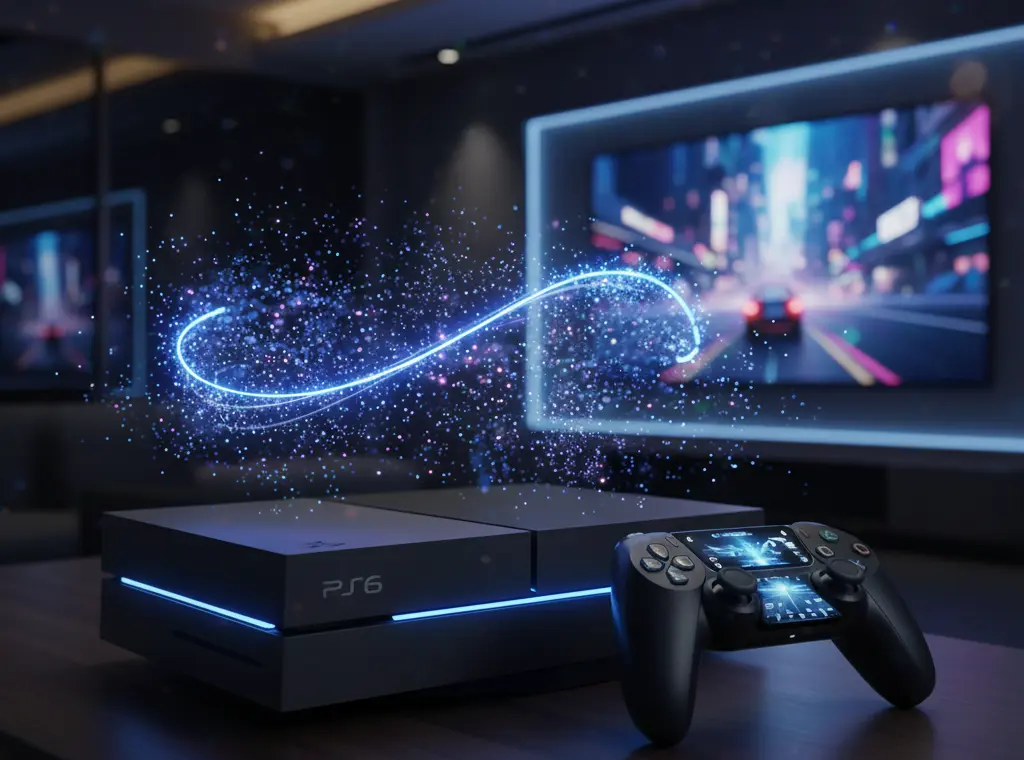
The console PlayStation 6 hype is officially here. While Sony just dropped the PS5 Pro (read our complete comparison guide here), the gaming world is already buzzing with PlayStation 6 console design speculation, leaked specs, and tantalizing hints about what’s coming next.
Here’s what makes this so interesting: Sony has reportedly teased the PlayStation 6 console through patent filings and strategic comments from executives, giving us genuine clues instead of pure speculation. After analyzing leaked documents, industry insider reports, and Sony’s design evolution patterns, I’m breaking down everything we actually know—and everything we can reasonably predict—about the new PlayStation 6 console.
Whether you’re a hardware enthusiast tracking every rumor, a casual gamer planning your next upgrade, or someone still choosing between current options (PS5 vs PS5 Pro breakdown here), this comprehensive guide covers the PlayStation 6 console release date predictions, design possibilities, and why Sony’s PlayStation 6 console isn’t going to be completely discless despite what some rumors suggest.
PlayStation 6 Console Release Date: When Can We Expect It?
Let’s address the biggest question first: when is the PlayStation 6 console actually coming?
Most realistic PlayStation 6 console release date window: November 2027 or Holiday 2028
This timeline isn’t random guessing. Sony follows predictable patterns:
- PS1 to PS2: 6 years
- PS2 to PS3: 6 years
- PS3 to PS4: 7 years
- PS4 to PS5: 7 years
- PS5 to PS6: Likely 7-8 years (2027-2028)
Why this matters: The PS5 launched November 2020. Adding seven years puts us at November 2027. However, the PS5 Pro’s late 2024 launch might push the new PlayStation 6 console to 2028, giving the Pro model adequate market time.
Some PlayStation 6 console news outlets suggest 2026, but that’s unrealistically aggressive. Sony won’t cannibalize PS5 Pro sales that quickly. The console PlayStation 6 needs proper development time, and rushing launches creates disaster (remember PS3’s troubled start?).
Sony Has Teased Its Upcoming PlayStation 6 Console: What We Actually Know
Contrary to wild speculation, Sony has reportedly teased the PlayStation 6 console through official channels—just not in flashy press releases.
Official Hints and Confirmations
Patent filings: Sony filed several hardware patents in 2023-2024 showing advanced cooling systems, modular component designs, and new controller technologies. These aren’t for PS5—they’re too advanced. This is PlayStation 6 console groundwork.
Executive statements: Sony Interactive Entertainment executives mentioned “next-generation planning” in investor calls, confirming active PS6 development.
Developer outreach: Multiple game studios report receiving preliminary technical specifications for “future PlayStation hardware” under strict NDAs.
Partnership extensions: Sony renewed and expanded its AMD partnership through 2028, strongly suggesting the console PlayStation 6 uses next-gen AMD architecture.
What Sony Hasn’t Said (But We Can Infer)
Sony hasn’t officially announced the PlayStation 6 console—they’re still selling PS5 Pro. But the groundwork is unmistakably being laid. Development cycles for consoles take 4-5 years, meaning Sony’s teams are deep into PlayStation 6 console design right now.
PlayStation 6 Console Design Speculation: The Physical Form Factor
Now we get into the fun part—what will the console PlayStation 6 actually look like sitting in your entertainment center?
Learning from PS5’s Design Wins and Losses
What worked with PS5:
- Distinctive futuristic aesthetic
- Excellent thermal performance
- Quiet operation (mostly)
- Easy storage expansion
What needs fixing:
- Absolutely massive size (biggest console ever)
- Limited launch storage capacity
- Glossy plastic fingerprint magnet sections
- Limited customization options initially
Predicted PlayStation 6 Console Dimensions
Based on manufacturing advances and Sony’s design trajectory, here’s what seems realistic:
Size prediction: 25-30% smaller than original PS5, roughly similar to PS4 Pro dimensions
- Width: Approximately 295-310mm (vs PS5’s 390mm)
- Height: Around 85-95mm (vs PS5’s 104mm)
- Depth: Roughly 240-255mm (vs PS5’s 260mm)
Why smaller is possible: By 2027-2028, AMD’s chips will use 3nm or 2nm manufacturing processes. These run cooler and require less space than current 7nm/6nm technology. The console PlayStation 6 can pack more power into less space.
Aesthetic Direction: Modern Minimalism Meets Gaming
The PlayStation 6 console design speculation strongly suggests Sony moves away from PS5’s bold sculptural look toward refined minimalism.
Predicted design language:
- Softer curves than PS5’s aggressive angles
- Premium matte finishes (no more glossy fingerprint traps)
- Subtle metallic accents (brushed aluminum or titanium-look)
- Understated customizable LED lighting
- Available in multiple colors at launch (black, white, possibly silver)
Think premium electronics aesthetic—something that looks at home in a modern living room without screaming “GAMING CONSOLE” quite so loudly.
Sony’s PlayStation 6 Console Isn’t Going to Be Completely Discless: The Physical Media Debate
One of the hottest PlayStation 6 console news topics is disc drive support. Despite digital gaming’s growth, here’s why Sony’s PlayStation 6 console isn’t going to be completely discless.
The Digital Reality Check
Yes, digital game sales exceed physical in many markets. Yes, younger gamers prefer digital convenience. But completely eliminating physical media in 2027-2028 would alienate significant consumer segments.
Why Sony keeps disc support:
Consumer pushback: The backlash against Xbox’s attempted always-online Xbox One proved gamers value physical media ownership rights.
International markets: Many regions have unreliable internet infrastructure making digital-only impractical.
Used game ecosystem: Physical disc market remains economically vital for budget-conscious gamers.
Movie collections: Blu-ray movie enthusiasts represent a meaningful consumer group.
Backward compatibility: PS5 disc libraries need support on PS6 for true backwards compatibility.
The Modular Solution
Rather than including disc drives in every unit, the new PlayStation 6 console likely follows PS5 Pro’s modular approach:
Base console: Ships digital-only at lower price point
Optional disc module: Attachable drive sold separately for those wanting physical media
This strategy lets Sony push digital adoption while avoiding the controversy of completely eliminating consumer choice. Sony’s PlayStation 6 console isn’t going to be completely discless—it just makes disc drives optional rather than standard.
PlayStation 6 Handheld Console Leak: The Portable Gaming Factor
Recent PlayStation 6 handheld console leak reports sent the gaming community into speculation overdrive. Let’s separate credible information from wishful thinking.
What the Leaks Actually Say
A leaker reveals technical details about rumored PlayStation 6 handheld console possibilities, but let’s be clear: this wouldn’t be the console PlayStation 6 itself—it would be a companion device.
Most credible scenario: A PlayStation Portal successor that streams PS6 games rather than running them natively. Think Nintendo Switch’s form factor but with cloud streaming PS6 titles.
Less likely scenario: A true standalone handheld running PS6 games locally with downgraded performance.
Realistic assessment: If Sony creates a PlayStation 6 handheld console, it launches well after the main console PlayStation 6—probably 2029-2030—as an ecosystem expansion rather than replacement.
Why Handheld Matters to Console Design
If Sony seriously pursues handheld integration, the main console PlayStation 6 needs architecture supporting efficient game streaming and Remote Play functionality. This influences:
- Network chip selection (WiFi 7, faster Ethernet)
- Compression/encoding hardware
- Power management for always-available streaming
- Cloud infrastructure investments
Console PlayStation 6 Technical Specifications: What Powers Next-Gen
PlayStation 6 console design speculation connects directly to anticipated internal hardware. Physical design serves the components inside.
Predicted Core Components
CPU: AMD Zen 6 architecture, 8-12 cores, manufactured on 3nm process. Significant performance jump while running cooler than current chips.
GPU: AMD RDNA 5 or RDNA 6 architecture with hardware ray tracing Level 3. Target: 60+ teraflops performance (vs PS5 Pro’s 33 teraflops).
RAM: 32GB GDDR7 memory offering massive bandwidth improvements over current GDDR6.
Storage: 2TB base internal storage (finally!), PCIe 5.0 SSD with 14GB/s+ speeds (vs PS5’s 5.5GB/s).
Cooling: Advanced vapor chamber covering 80%+ of board area, liquid metal thermal interface, 140mm ultra-quiet fan.
Power consumption: Approximately 300-350W maximum despite increased performance (efficiency gains from advanced manufacturing).
What This Means for Design
Smaller, cooler-running chips enable:
- More compact console PlayStation 6 dimensions
- Quieter operation during intensive gaming
- Lower electricity costs for consumers
- Reduced environmental impact
The Modular Design Philosophy: PlayStation 6’s Biggest Innovation
The new PlayStation 6 console likely embraces modularity more aggressively than any previous PlayStation.
Why Modular Makes Perfect Sense
The PS5 Pro introduced detachable disc drives—a test run for PlayStation 6 console design philosophy.
Manufacturing benefits:
- Produce one base unit with optional components
- Reduced SKU complexity
- Easier inventory management
- Lower shipping costs (smaller boxes)
Consumer benefits:
- Buy digital now, add disc drive later
- Upgrade individual components potentially
- Customize appearance with swappable plates
- Repair/replace failed components individually
Predicted Modular PlayStation 6 Components
Disc drive module: Obviously continues from PS5 Pro, possibly with 8K Blu-ray support.
Cooling enhancement modules: Optional upgraded cooling for enthusiasts or hot climates.
Storage expansion bays: Proprietary Sony storage modules that attach externally but integrate seamlessly.
Faceplate system: Extensive range of official and third-party customization plates.
Stand variations: Multiple stand designs for horizontal, vertical, or wall-mount setups.
Connectivity and Ports: Console PlayStation 6’s Interface with the World
How we physically connect controllers, displays, storage, and accessories matters tremendously.
Front Panel Predictions
- 2-3 USB-C ports (USB 4.0 standard supporting 40Gbps speeds)
- Power button (physical, tactile—not touch-sensitive)
- Disc slot (on disc edition models)
- Integrated controller charging (magnetic contacts or wireless charging pad)
Rear Panel Configuration
- HDMI 2.2 or HDMI 3.0 (supporting 8K/120fps or 4K/240fps)
- 10Gbps Ethernet port (future-proofing network speeds)
- 2-3 additional USB-C ports
- Dedicated VR connector (if Sony continues VR investment)
- Power connector (internal power supply maintained)
What Disappears
Optical audio: Almost certainly eliminated. HDMI handles everything.
Legacy USB-A ports: Maybe one remains for backward compatibility, but USB-C dominates by 2027.
Advanced Cooling Engineering: Why It Drives Everything
The console PlayStation 6 faces a fundamental challenge: more power generates more heat. Cooling solutions directly determine physical design possibilities.
The Thermal Challenge
PlayStation 6 will pack significantly more processing power than PS5 Pro. How does Sony cool it without creating another massive console or jet-engine noise levels?
Predicted Cooling Innovations
Massive vapor chamber: Covering 75-80% of internal board area, spreading heat evenly across the entire system rather than creating hotspots.
Liquid metal expansion: Not just CPU application but potentially GPU and memory controllers too.
Advanced fan engineering: Single 140mm or dual 120mm fans with fluid dynamic bearings, spinning slower for equivalent airflow with dramatically reduced noise.
Intelligent thermal management: AI-powered cooling that predicts workload and adjusts fan speed proactively rather than reactively.
Strategic airflow channels: Computational fluid dynamics-optimized internal pathways maximizing cooling efficiency.
Materials innovation: Graphene-enhanced thermal pads conducting heat 5-10x better than traditional solutions.
Noise Level Target
Sony likely targets under 35 decibels during intensive gaming—quieter than PS5, comparable to premium laptops. The new PlayStation 6 console should be nearly silent during typical gameplay.
Display Technology and Visual Output
The PlayStation 6 console isn’t just about processing power—it’s about delivering stunning visuals to your screen.
Predicted Display Capabilities
Resolution support: Native 8K output capability, though practical gaming at 4K with higher frame rates more realistic.
Frame rates: 4K at 120fps standard, with 4K/240fps possible in competitive titles. Some games might offer 8K/60fps modes.
HDR advancement: Support for HDR10+, Dolby Vision gaming, and whatever new HDR standards emerge by 2027-2028.
Variable refresh rate: Full HDMI VRR support from 20Hz to 240Hz for tear-free gaming.
Wireless Display Potential
By 2027-2028, wireless display technology might mature enough for gaming. The console PlayStation 6 could support:
WiFi 7-based wireless HDMI: Low-latency 4K/120fps streaming to compatible displays, eliminating cable clutter.
Realistic assessment: Available but not required. Serious gamers stick with wired connections for reliability and lowest latency.
VR Integration: PlayStation VR 3 and Console Design
If Sony remains committed to virtual reality (signs suggest they are), the console PlayStation 6 must accommodate next-generation VR experiences.
VR Technology Evolution by 2027-2028
Wireless VR: Technology matures enough for low-latency, high-resolution wireless headsets by PlayStation 6’s launch.
Inside-out tracking: No external cameras needed—headset tracks itself using built-in sensors.
Higher resolution: 4K per eye or better, dramatically improved visual clarity.
Eye tracking standard: Foveated rendering massively improves performance by rendering only what you’re looking at in full detail.
PlayStation 6 Console Design Accommodations
Dedicated VR processor: Separate chip handling VR workload, preventing main system performance impact.
Wireless VR antenna: Built-in high-bandwidth wireless transmitter for PSVR3 headsets.
VR controller charging: Integrated charging solution for next-gen VR controllers.
Design consideration: Ventilation and cooling accounting for VR processing thermal load.
Backwards Compatibility: Supporting Your PlayStation Library
The new PlayStation 6 console needs to respect your existing game investment—Sony learned this lesson.
Expected Compatibility
PS5 games: Full native support, likely with performance enhancements (higher frame rates, faster loading).
PS4 games: Continued support through PS5 compatibility layer.
PS3/PS2/PS1: Possibly expanded backwards compatibility through improved emulation technology.
Controllers: DualSense controllers from PS5 should work with PS6 games (potentially with some feature limitations).
Accessories: PSVR2, headsets, and most PS5 accessories likely compatible.
Design Implications
Maintaining compatibility prevents radical architectural changes. The console PlayStation 6 becomes evolutionary rather than revolutionary—which is actually smart business.
Sustainability and Environmental Design
Modern electronics design increasingly prioritizes environmental responsibility. The PlayStation 6 console must address sustainability.
Predicted Eco-Friendly Features
Recycled materials: 50-60% recycled plastic content in housing, increased recycled metal components.
Energy efficiency: Advanced power management potentially reducing consumption 20-30% versus equivalent PS5 power levels.
Modular repairability: Design enabling component replacement rather than complete unit disposal.
Reduced packaging: Smaller console means smaller boxes, less shipping environmental impact.
Biodegradable materials: Some plastic components might use plant-based alternatives.
Extended lifespan design: Built to last 8-10 years rather than planned obsolescence.
Comparing Design Evolution: PS5 Pro to Console PlayStation 6
Understanding Sony’s design philosophy trajectory helps contextualize what’s coming.
Design Evolution Path
PS5 (2020): Bold, futuristic, massive. Revolutionary aesthetic departure prioritizing distinctive appearance.
PS5 Pro (2024): Refined PS5 language, modular disc drive, slightly more compact. Evolutionary improvement.
Console PlayStation 6 (2027-2028 prediction): Sophisticated minimalism, significantly smaller, extensively modular. Mature evolution toward premium electronics aesthetic.
What This Means for Current Buyers
If you’re shopping now, understand the PlayStation 6 console will improve on PS5 Pro but won’t revolutionize the experience like PS4 to PS5 did.
Check our complete PS5 vs PS5 Pro comparison to determine which current console fits your needs while we wait years for the new PlayStation 6 console.
The Most Realistic Console PlayStation 6 Design Prediction
Combining all PlayStation 6 console news, patents, leaks, and Sony’s patterns, here’s my most realistic prediction:
Physical dimensions: Approximately 300mm × 90mm × 250mm—noticeably more compact than PS5.
Aesthetic: Premium matte finish with subtle metallic accents. Soft curved edges. Understated customizable LED lighting. Available in black, white, and silver at launch.
Cooling system: Large vapor chamber, liquid metal thermal interface, ultra-quiet 140mm fan. Under 35dB operation.
Connectivity: Front USB-C ports with integrated controller charging. Rear HDMI 2.2/3.0, 10Gbps Ethernet, multiple USB-C. Optional wireless display support.
Modularity: Ships digital-only base unit. Optional disc drive attachment. Extensive faceplate customization system. Multiple stand options.
Storage: 2TB internal PCIe 5.0 SSD. Expandable via M.2 slot and potentially proprietary external modules.
Power: Internal supply, approximately 300-350W maximum with aggressive power management.
Special features: Integrated controller charging, enhanced TV integration, native wireless VR support, AI-powered thermal management.
Sustainability: 50%+ recycled materials, user-repairable design, energy-efficient operation.
PlayStation 6 Console News: Staying Updated
The console PlayStation 6 remains years from official announcement, but PlayStation 6 console news emerges regularly through:
Patent filings: Sony files dozens yearly—watching these reveals technical direction.
Industry leaks: Developers under NDA occasionally leak preliminary specs.
Executive statements: Sony Interactive Entertainment executives sometimes hint at future plans in investor calls.
Partnership announcements: Component supplier deals suggest manufacturing timelines.
Job listings: Sony’s recruitment posts sometimes reveal project details.
Follow gaming news outlets covering PlayStation 6 console news, but treat unverified leaks skeptically. When that leaker reveals technical details about rumored PlayStation 6 handheld console or main system, verify sources before believing.
Is the PlayStation 6 the Last Console? The Streaming Question
Some speculate whether the console PlayStation 6 represents the last traditional gaming console before full cloud streaming dominance.
Reality check: Not even close.
Why traditional consoles survive:
- Internet infrastructure isn’t universal or reliable enough
- Input latency matters tremendously for gaming
- Consumers value ownership over subscriptions
- Technical benefits of local processing remain significant
- Gaming enthusiasts prefer dedicated hardware
The console PlayStation 6 isn’t the PlayStation 6 last console—expect PS7 eventually, though the timeline might extend as cloud gaming matures.
Traditional consoles and cloud services will coexist, each serving different consumer needs. The new PlayStation 6 console might integrate streaming features, but local processing remains its foundation.
Final Thoughts on Console PlayStation 6 Speculation
We’re still 3-4 years from the new PlayStation 6 console’s actual reveal. Much remains speculation based on patents, industry trends, and educated guessing. Sony could surprise us—they often do.
But the trajectory feels clear: the console PlayStation 6 will refine and improve PS5’s foundation rather than reinventing console gaming. Expect significant power increases, meaningful size reductions, extensive modularity, sophisticated aesthetics, and smart sustainability choices.
For gamers shopping today, don’t wait years for the PlayStation 6 console. The PS5 versus PS5 Pro decision matters now. Both current consoles deliver incredible gaming experiences, and waiting means missing thousands of hours enjoying this generation’s amazing titles.
When Sony finally announces the console PlayStation 6, we’ll all geek out together over the official details. Until then, choose your current-gen system wisely and enjoy gaming’s incredible present instead of obsessing over its distant future.
Frequently Asked Questions About Console PlayStation 6
What is the PlayStation 6 console release date?
Most realistic estimates point to November 2027 or Holiday 2028. Sony follows 7-8 year console cycles, and PS5 launched November 2020. The PS5 Pro’s late 2024 release might push the PlayStation 6 console to 2028.
Has Sony officially announced the console PlayStation 6?
Not formally, but Sony has reportedly teased the PlayStation 6 console through patent filings and executive statements confirming “next-generation planning.” Active development is clearly underway.
Will the new PlayStation 6 console support disc games?
Yes. Despite digital growth, Sony’s PlayStation 6 console isn’t going to be completely discless. Expect a modular approach: digital-only base unit with optional disc drive attachment sold separately.
How much will the console PlayStation 6 cost?
Based on typical Sony pricing and inflation trends, expect $499-599 for digital edition, $599-699 for disc edition. Premium “Pro” version might launch later at $799-899.
Is the PlayStation 6 handheld console leak real?
A leaker reveals technical details about rumored PlayStation 6 handheld console possibilities, but this would be a companion streaming device (like PlayStation Portal), not the main console PlayStation 6 itself.
Will the console PlayStation 6 support 8K gaming?
Technically capable of 8K output, yes. Practical 8K gaming in most titles? Unlikely. 4K at 120fps+ will be the sweet spot for performance and visual quality balance.
Should I wait for the PlayStation 6 console or buy PS5/PS5 Pro now?
Don’t wait 3+ years. That’s thousands of gaming hours you’d miss. Buy the PS5 or PS5 Pro that fits your current needs, enjoy this generation’s incredible games, and upgrade to the console PlayStation 6 when it actually launches.
Will the new PlayStation 6 console be backwards compatible?
Almost certainly yes. Expect full PS5 game support, continued PS4 compatibility, and possibly expanded PS3/PS2/PS1 support through improved emulation.
What makes the console PlayStation 6 better than PS5 Pro?
Significantly more powerful GPU (60+ teraflops vs 33), more RAM (32GB vs 18GB), faster storage (PCIe 5.0 vs 4.0), smaller physical size, more advanced cooling, extensive modularity, and cutting-edge features not possible with current technology.
Is this the PlayStation 6 last console before streaming takes over?
No. Traditional consoles will continue for multiple generations. Cloud streaming and local hardware will coexist, each serving different consumer needs. Expect PlayStation 7 eventually.
This console PlayStation 6 design speculation and news article will be regularly updated as patents emerge, leaks surface, and official information releases. Bookmark for the latest PlayStation 6 console updates and analysis.