
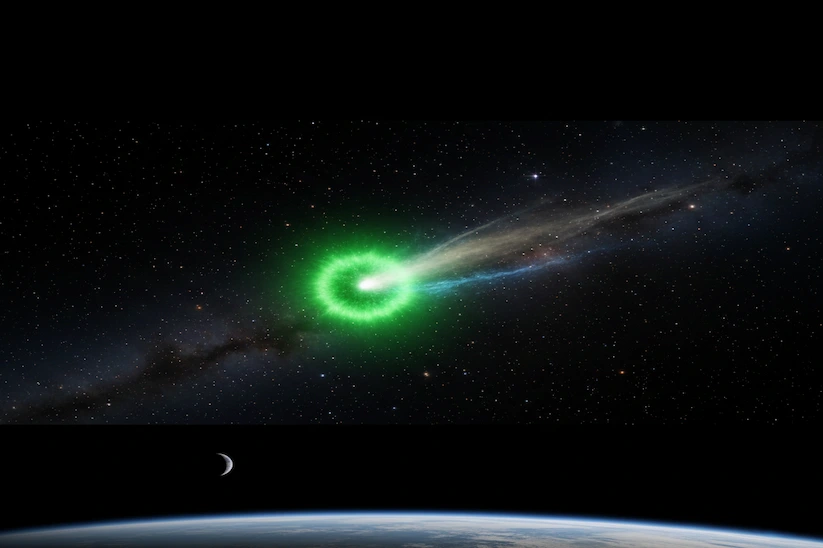
Something’s happening right above our heads that most people don’t even know about.
Interstellar comet 3I/ATLAS is passing through our solar system this month. Not from the Kuiper Belt. Not from the Oort Cloud. From outside our solar system entirely—another star, another part of the galaxy we can’t even pinpoint.
December 19 marks its closest approach to Earth. After that? Gone forever.
We’ve only confirmed three objects like this in all of recorded history. This is the third.
Three Visitors, Billions of Years
Think about how many comets we’ve tracked over the centuries. Hundreds? Thousands? Most of them orbit our Sun, swinging back around every few decades or centuries like clockwork.
But objects from interstellar space? Just three confirmed. That’s it.
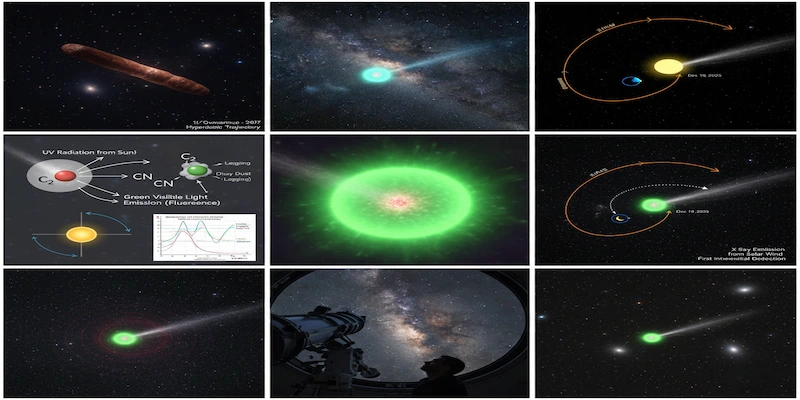
ʻOumuamua (2017) was first. That thing caused chaos in the astronomy community—cigar-shaped, tumbling weirdly, accelerating in ways nobody expected. Some scientists genuinely wondered if it might be artificial. Most settled on “probably natural but definitely strange.” The debates got heated.
2I/Borisov showed up in 2019. More traditional comet-like appearance. Less controversial, more straightforward data collection.
Now we’ve got 3I/ATLAS, spotted July 1, 2025, by the ATLAS telescope network in Hawaii. And honestly? This one’s putting on the best show of the three—bright green glow, backwards tail, even X-ray emissions nobody saw coming.
How do astronomers know for certain these originated outside our solar system? The math doesn’t lie. Regular comets follow elliptical orbits, gravitationally bound to the Sun. These three trace hyperbolic paths—they’re not captured by anything here, just passing through on their way to… somewhere else.
December 19: Panic Not Required
Let me stop you before you even start: this comet will not hit Earth.
On December 19, it’ll cruise past at roughly 167 million miles away. That’s about 1.8 times the distance from Earth to the Sun.
Yeah, some websites are definitely milking the drama (because clicks), but NASA and every legitimate space agency has been completely clear. This is an observation opportunity, nothing more.
The Moon sits about 240,000 miles away. This comet will pass more than 400 times farther than that. You’re not going to feel it, see it with naked eyes, or need to worry about it in any capacity.
December 19 only matters because that’s when Earth’s position gives us the best viewing angle before 3I/ATLAS speeds away permanently.
Why’s It Glowing Green?
Recent photos from observatories like Gemini North show 3I/ATLAS with this almost neon green haze around its core.
That’s not image processing or artistic license. That’s actual chemistry.
When UV radiation from the Sun hits certain molecules in the comet’s coma—specifically diatomic carbon (C₂) and cyanogen (CN)—those molecules absorb energy and re-emit it as visible green light. Same basic physics as fluorescence.
What’s genuinely interesting here: the presence of these specific molecules means 3I/ATLAS has a chemical makeup remarkably similar to comets born right here in our solar system. It traveled from another stellar system entirely, yet it’s composed of the same icy volatiles we see in “local” comets.
That suggests comet formation might follow similar patterns across different star systems. Which tells us something fundamental about how planetary systems develop throughout the galaxy.
The Tail That Points Backward (Sort Of)
One of the weirder visual features: 3I/ATLAS developed what astronomers call an “anti-tail”—looks like it’s pointing toward the Sun instead of away.
Anyone who paid attention in school knows comet tails should stream away from the Sun because solar wind pushes gas and dust outward. So what’s going on?
Optical illusion, basically.
Regular comet tails are made of lightweight gas and microscopic dust particles that get blown directly away by radiation pressure. The anti-tail? That’s much heavier dust grains that can’t be pushed as easily. These particles lag behind the comet as it moves through its orbit.
When Earth crosses the plane of the comet’s orbital path—which is happening right now—our viewing angle makes those lagging particles appear to point sunward. They’re not actually moving toward the Sun; we’re just seeing the dust trail from a specific geometric perspective.
Recent measurements suggest this anti-tail extends over 250,000 miles. Longer than the Earth-Moon distance. That’s legitimately impressive even for people who analyze comet images regularly.
The Speed Gives It Away
Want proof this thing came from outside our solar system? Look at how fast it’s moving.
Near perihelion (closest to the Sun), 3I/ATLAS hits around 68 kilometers per second. When it exits back into interstellar space, it’ll still be cruising at roughly 58 km/s.
Solar system comets typically move at 10-30 km/s. The difference is stark.
That velocity confirms 3I/ATLAS originated somewhere beyond the Sun’s gravitational reach and has enough momentum to escape permanently. It arrived fast, it’s leaving fast, and nothing in our solar system can slow it down enough to trap it in orbit.
Why Scientists Can’t Stop Talking About This
Beyond the obvious “cool space thing” factor, why is the research community so excited?
We can study physical material from another star system without leaving Earth.
Let that sink in. This comet contains matter that condensed in a completely different stellar environment—maybe around a star that formed in a different region of the galaxy, under different conditions, possibly billions of years ago.
By analyzing its spectral signature, chemical makeup, and behavior, researchers can answer questions about planetary system formation elsewhere in the universe. Are the building blocks universal? Do different stellar environments produce different comet types?
The X-ray discovery is particularly wild. Scientists detected faint X-ray emissions from 3I/ATLAS’s interaction with solar wind—the first time anyone’s observed X-ray signals from an interstellar object. This isn’t just a novelty; it’s providing entirely new data about how these visitors behave when encountering stellar radiation.
Every spectrum analyzed, every trajectory calculation refined, every photometric measurement recorded—all of it builds our understanding of the galaxy beyond our immediate neighborhood.
Viewing Reality Check
I need to be straight with you: if you’re expecting to step outside and see a bright comet blazing across the sky, that’s not happening.
3I/ATLAS is dim. Really dim. “You need to know exactly where to look with proper equipment” dim.
Decent backyard telescope under dark skies? Maybe you’ll spot it as a faint fuzzy patch. Binoculars? Probably not. Naked eye? Definitely not.
Amateur astronomers with solid equipment and astrophotography setups have been capturing it successfully, so it’s absolutely visible—just not to casual observers. If you’re thinking famous naked-eye comets like Hale-Bopp or NEOWISE, this isn’t that kind of spectacle.
But if you’re serious about stargazing and want a legitimate challenge, this is your shot. How often do you get to photograph material from another star system?
One Pass, Then Gone
Here’s the part that actually gets to me.
After 3I/ATLAS finishes its journey through our solar system, it’s gone. Not “see you in 75 years” like Halley’s. Not “catch it next century.”
Permanently gone.
Its hyperbolic trajectory means it’s not gravitationally bound to our Sun. It’ll swing past, gain even more velocity from the Sun’s gravity, then accelerate back into the darkness between stars.
Maybe millions of years from now it’ll pass near another star. Maybe it’ll get captured into a different solar system eventually. Or maybe it’ll drift through the galaxy indefinitely, a frozen relic from one stellar system passing through countless others.
December 2025 is the only chance any human—past, present, or future—will ever have to observe this object.
That’s what makes this genuinely special. Not “once in a lifetime.” Once in all of human history.
The Essential Info
Discovery: July 1, 2025 (ATLAS telescope, Hawaii)
Type: Interstellar comet (3I = third confirmed interstellar object)
Closest to Earth: December 19, 2025
Distance at closest approach: ~167 million miles (1.8 AU)
Velocity near Sun: ~68 km/s
Will it return? Never—hyperbolic escape trajectory
Threat to Earth: Zero
Key features: Green coma from carbon compounds, prominent anti-tail, X-ray emissions, confirmed interstellar origin
Why This Matters More Than You Think
Look, “distant comet passes safely” doesn’t exactly grab headlines compared to everything else competing for your attention.
But consider what’s actually happening here.
We’re studying physical matter from another star system without building an interstellar spacecraft. We’re analyzing material that formed in a completely different stellar environment, possibly billions of years ago, using Earth-based telescopes.
That’s not just scientifically valuable. That’s genuinely profound.
These interstellar visitors prove our solar system isn’t isolated. We’re part of a galaxy where matter circulates between stars. Maybe organic compounds spread this way. Maybe chemical precursors to life travel between stellar systems on objects exactly like this.
And honestly? There’s something deeply human about looking up at a comet knowing it came from somewhere completely different. Makes you feel small and connected at the same time.
Plus—and I can’t stress this enough—this is legitimately once-in-all-of-human-history. Not marketing hyperbole. This specific object will never be observable by human eyes again after it leaves.
Final Take
Interstellar comet 3I/ATLAS won’t hurt us. It’s not ominous. It’s just an incredibly rare cosmic visitor offering a brief window to study material from beyond our solar system.
If you care at all about space or astronomy—even just a little—pay attention these next few weeks.
This is history unfolding in real time. Something that crossed distances we can barely comprehend, briefly illuminated by our Sun’s light, soon disappearing back into the void between stars.
That’s not just a news story. That’s genuinely special.
Latest photos and observations: Follow NASA, Gemini Observatory, and ESO for real-time updates as 3I/ATLAS makes its December 19 closest approach.
The Questions Everyone Keeps Asking
None. Zero. The trajectory has been calculated with extreme precision. It passes at a distance more than 400 times farther than the Moon. We’re completely safe.
That’s the million-dollar question nobody can definitively answer. Based on how long it’s likely been traveling through interstellar space, it could have originated from a star system hundreds or even thousands of light-years away. We may never know its birthplace.
Three reasons: space is unimaginably vast, these objects are small and dark, and they’re moving extremely fast. We’ve only had the telescope technology and automated survey programs to reliably detect them for about 10-15 years. As our detection capabilities improve, we’ll probably start finding more.
Every observation confirms it’s a natural comet. The green glow alone proves it’s releasing gases (specifically carbon compounds) exactly like regular comets. The dust trail, the speed, the composition—everything matches natural comet behavior. So no, almost certainly not artificial.
Probably, yes. Major observatories are tracking it continuously, and as December 19 approaches, viewing conditions should improve. NASA, ESO (European Southern Observatory), and various other facilities are releasing new images regularly.
It’ll just keep coasting through the Milky Way. No propulsion, no drag (space is basically a vacuum), just endless drifting. Eventually it might pass near another star, or it might wander between stars for millions of years. There’s no way to predict its long-term fate.