
If you’ve ever seen a golden retriever puppy sister meeting for the first time, you know exactly what I’m talking about. That moment when those soft, curious eyes lock onto the tiny ball of fur, when that tail starts wagging so hard it could power a small fan, and when you realize you’re about to witness one of the purest forms of love in the animal kingdom.
I’ll never forget the day we brought home Maisie to meet her big sister, Bailey. My hands were literally shaking as I carried that eight-week-old bundle through the door. Would Bailey be jealous? Protective? Confused? All those “what-ifs” racing through my mind disappeared the moment Bailey’s nose touched Maisie’s tiny head. The gentleness, the immediate acceptance, the pure joy—it was like watching a Disney movie unfold in my living room.
Why Golden Retrievers Make Perfect Big Sisters
Here’s the thing about golden retrievers that most people don’t realize until they see it firsthand: they’re wired differently. I’ve had other dog breeds over the years—terriers, beagles, even a stubborn bulldog—but nothing compares to how a golden handles a new puppy.
Bailey was three years old when we decided to get Maisie. People kept warning me: “She’ll be territorial,” “Dogs get jealous,” “You’re disrupting her routine.” You know what happened? The complete opposite. It’s like Bailey had been waiting her whole life for this moment.
The breed’s hunting background actually plays into this. Goldens were bred to work in teams, to retrieve gently without damaging game, to follow commands while still thinking independently. That translates into a dog who understands cooperation, who knows how to control their strength, and who genuinely enjoys having a companion.
But it’s more than genetics. There’s an emotional intelligence in golden retrievers that still surprises me. Bailey could sense Maisie’s anxiety on day one. Without any prompting from me, she laid down to make herself less intimidating. She brought her favorite toy over—the one she never shares with anyone—and dropped it at Maisie’s feet. That wasn’t training. That was pure instinct.
That First Meeting Will Test Your Nerves (And Melt Your Heart)
Let me be brutally honest: I nearly chickened out three times before we actually introduced them. I’d read every article, watched every YouTube video, consulted with our vet, talked to other golden owners. Still terrified.
We chose our backyard for neutral territory. Not the house where Bailey had established her kingdom over three years. Not a public park where distractions might interfere. Just our familiar but outdoor space where both dogs could feel somewhat comfortable.
I had my husband handle Bailey’s leash while I carried Maisie. The moment Bailey saw that puppy carrier, her entire body started vibrating with excitement. Not aggressive excitement—that happy, can’t-contain-myself golden retriever energy we all know too well.
When we set Maisie down (still on a leash for safety), Bailey’s approach was surprisingly methodical. She circled first, keeping distance, just observing. Then came the sniffing phase. Nose to nose lasted maybe five seconds before Bailey moved to full-body inspection. Top to bottom, front to back, Maisie got the complete golden retriever quality check.
What happened next still makes me emotional. Bailey did this little play bow—front legs stretched forward, butt in the air, tail wagging like crazy. She was inviting an eight-week-old puppy who could barely walk straight to play with her. Maisie’s response? She stumbled forward and tripped over her own feet trying to bow back.
That’s when I knew we’d made the right choice.
The rest of that first meeting involved Bailey lying down while Maisie climbed all over her, chewing on her ears, batting at her face. Bailey took it like a champ, occasionally glancing at me like “Are you seeing this? I’m a big sister now!”
The Reality Nobody Talks About: Week One Is Exhausting
Social media shows you those perfect, Instagram-worthy moments of golden retrievers cuddling with new puppies. What they don’t show you is the chaos, the accidents, the sleep deprivation, and the moments when you question every life choice that led you to having two dogs.
Day one was magical but draining. Maisie cried every hour through the night. Bailey, who typically sleeps through anything, kept waking up and whining at Maisie’s crate. By 3 AM, I was sitting on the floor between Bailey’s bed and Maisie’s crate, one hand on each dog, running on pure caffeine and determination.
Day two brought new challenges. Maisie discovered that Bailey’s tail made an excellent chew toy. Bailey discovered that puppies have razor-sharp teeth. I discovered that supervising two dogs is exponentially harder than watching one.
The turning point came on day three. I’d left the room for literally two minutes to grab coffee. When I came back, I found Bailey had dragged her bed over to Maisie’s crate. She was lying with her nose pressed against the bars, and Maisie was pressed against the other side, both of them completely content.
By day four, Bailey started doing this thing where she’d gently mouth Maisie when she got too rowdy. Not biting—just a gentle “hey, that’s enough” correction. It was dog communication at its finest, and it worked better than any training method I could’ve used.
Day five brought the first real play session. Not just Bailey tolerating puppy antics, but actual reciprocal play. They had this game where Bailey would lie down and let Maisie attack her tail, then she’d suddenly “catch” Maisie with her paws. Maisie would tumble over, scramble back up, and attack again. They played that game for twenty minutes straight.
Days six and seven showed me what the future would look like. The bond was solidifying. Bailey started seeking out Maisie for companionship. When Maisie napped, Bailey would position herself nearby. When Maisie ate, Bailey would lie down and watch (probably hoping for dropped kibble, let’s be real).
By the end of week one, they’d established routines I hadn’t taught them. Morning greeting ritual: Bailey would do a play bow, Maisie would respond, then they’d zoom around the backyard twice. Pre-bedtime ritual: they’d share a chew session, then both would drink from the water bowl before settling into their respective beds (which were now pushed right next to each other).
Details Matter: Setting Up For Success
The preparation work I did before bringing Maisie home made all the difference. I created what I called “safe zones” for each dog. Bailey’s was her usual bed in the corner of the living room, elevated slightly on a platform so Maisie couldn’t easily access it. Maisie’s was her crate with a blanket draped over it for den-like security.
Food stations were separated by an entire room. Bailey ate in the kitchen; Maisie got fed in the laundry room. Even though Bailey showed zero food aggression, I wasn’t taking chances with resources that dogs naturally guard.
Toy management became crucial by day three. Maisie wanted every single toy Bailey touched. My solution? Color-coded toys. Blue toys were Bailey’s special ones that Maisie couldn’t have. Red toys were Maisie’s puppy-safe options. Green toys were communal. It sounds excessive, but it eliminated so much potential conflict.
I also implemented what I called “Bailey time”—at least two hours daily where Maisie was in her crate or playpen, and Bailey got my undivided attention. We’d go for walks, do training sessions, or just cuddle on the couch. This prevented Bailey from associating Maisie’s presence with loss of attention.
The surprise hero tool? Baby gates. I installed them in doorways to create spaces where Bailey could escape if Maisie’s puppy energy became overwhelming. Bailey used them frequently those first two weeks, retreating to the bedroom for peace and quiet.
Watching Their Language Develop
Dogs communicate in ways we’re still learning to fully understand, and watching Bailey teach Maisie “golden retriever speak” was fascinating.
There was this soft “woof” Bailey would make—not a bark, not a growl, just a gentle vocalization. She used it specifically when Maisie’s play got too rough or when she wanted Maisie to follow her somewhere. Within a week, Maisie started making the same sound back.
Their play fighting looked violent to anyone who didn’t understand dog behavior. All teeth and growling and wrestling. But watch closely, and you’d see Bailey constantly adjusting her strength. When Maisie was eight weeks, Bailey barely touched her. As Maisie grew and got sturdier, Bailey gradually increased play intensity. She was gauging exactly how much the puppy could handle.
The mouth thing fascinated me. Dogs use their mouths like we use hands—to guide, to correct, to show affection. Bailey would gently grasp Maisie’s muzzle or neck scruff when Maisie needed redirection. Never hard enough to hurt, just enough to communicate. Maisie learned that “golden retriever hold” meant “pause and reconsider what you’re doing.”
Body blocking was another communication tool Bailey employed. If Maisie was heading somewhere she shouldn’t (like toward my shoes or the garbage can), Bailey would simply step in front of her. Physical but non-aggressive boundary setting. Brilliant, really.
When Things Get Complicated
Not every moment was Instagram-perfect, and I think it’s important to acknowledge that. Week two brought challenges I hadn’t anticipated.
Bailey started resource guarding me. Not aggressively, but she’d position herself between Maisie and me whenever I sat down. She’d push Maisie away (gently but firmly) if the puppy tried to climb into my lap. My veterinarian explained this was normal—Bailey was adjusting to sharing her primary resource (me) and needed reassurance.
The solution involved deliberately giving Bailey attention first, always. When I came home, I greeted Bailey before Maisie. During training treats, Bailey got hers first. When both dogs approached for petting, Bailey received the first touch. Within days, the guarding behavior disappeared. She just needed that confirmation that her place in the pack hierarchy remained unchanged.
Then there was the overprotective phase around week three. Bailey started getting anxious when other dogs approached Maisie at the park. Not aggressive, just hovering, positioning herself between Maisie and any potential threat. While sweet, it was preventing Maisie from normal puppy socialization.
I had to actively work on this, bringing Maisie to puppy playdates without Bailey, and taking Bailey to the dog park without Maisie. They needed individual experiences outside their sister relationship. It worked. Bailey relaxed once she learned Maisie could handle herself (to a degree).
The Transformation You’ll Witness
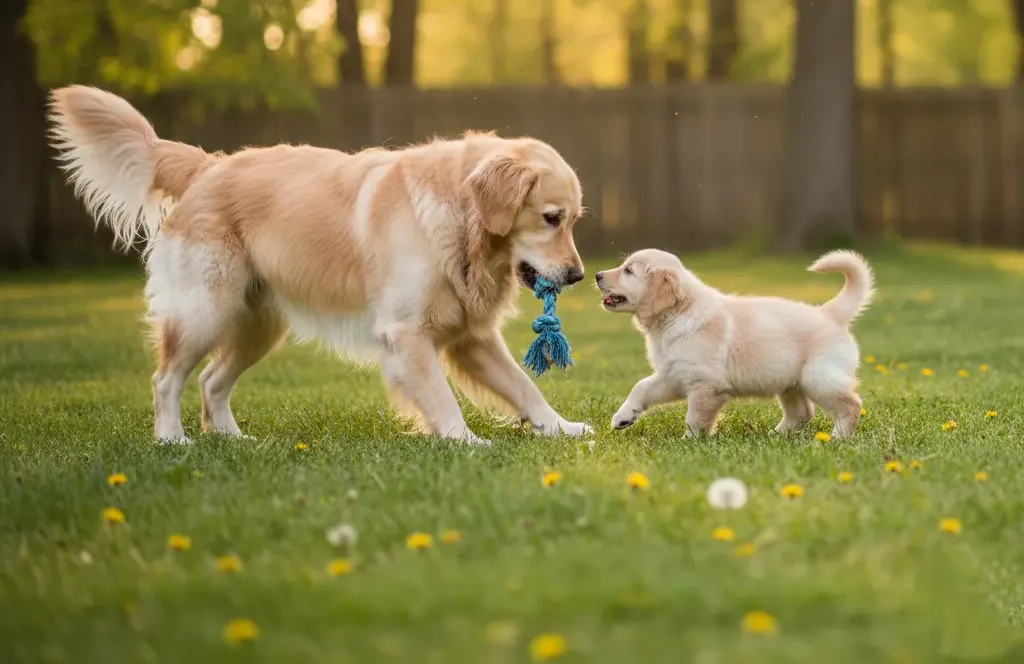
Around the two-month mark, something shifted. They weren’t just tolerating each other or even just getting along. They’d become genuinely bonded.
Bailey started showing behaviors I’d never seen before. She’d bring Maisie toys when the puppy looked bored. She’d lead Maisie to the water bowl if the puppy seemed thirsty. When Maisie had an upset stomach one night, Bailey refused to leave her side, even skipping her own dinner to stay with her sister.
Maisie, meanwhile, started mimicking everything Bailey did. Where Bailey slept, Maisie wanted to sleep. How Bailey carried toys (gently in her mouth), Maisie copied. When Bailey barked at the mailman, Maisie would bark too (even though she had no idea why).
The copying extended to training. I’d practice commands with Bailey, and Maisie would watch intently from the sidelines. Then when I worked with Maisie, she’d perform commands I hadn’t even taught her yet because she’d learned by observation.
Their play evolved from one-sided puppy attacks to genuinely reciprocal games. They developed their own version of tag, where one would grab a toy and run, and the other would chase. They’d switch roles naturally, without any human intervention.
The sleeping arrangements told the whole story of their relationship development. Week one: separate beds, two feet apart. Week four: separate beds pushed together. Week eight: Maisie sleeping half on Bailey’s bed. Week twelve: both dogs completely intertwined in Bailey’s bed, impossible to tell where one ended and the other began.
Real Talk About the Hard Parts
I got frustrated. Multiple times. There were moments I sat on the bathroom floor and cried because I felt overwhelmed and wondered if I’d made a terrible mistake.
House training two dogs (one being retrained due to puppy influence) was a nightmare. Maisie had accidents, which reminded Bailey that peeing indoors was an option she’d forgotten about. I went through more carpet cleaner in three weeks than in the previous three years.
The sleep deprivation hit hard. Between Maisie’s puppy crying and Bailey’s anxiety about puppy crying, I averaged maybe four hours of sleep nightly for the first month. My work suffered. My mood suffered. My husband and I snapped at each other over stupid things because we were exhausted.
The financial aspect nobody warns you about: double the vet bills, double the food costs, emergency runs to the pet store because you ran out of puppy pads at 9 PM, replacing every toy Maisie destroyed (which was most of them), and professional carpet cleaning services.
But here’s the thing—every single struggle was temporary. The house training resolved by month three. Sleep normalized by month two. The financial hit stabilized once we weren’t buying emergency supplies constantly.
What remained, what grew, what made everything worthwhile was watching these two golden retrievers build a relationship that honestly makes human friendships look complicated.
Why These Videos Go Viral (And Why We Can’t Stop Watching)
There’s something primal in our reaction to watching golden retrievers meet their puppy sisters. I’ve probably watched hundreds of these videos, and I cry at most of them. Not because I’m overly emotional (okay, maybe I am), but because they capture something pure.
We live in a complicated world where relationships come with conditions, where love often has strings attached, where trust must be earned over time. Then you watch a golden retriever meet a puppy for the first time, and within seconds—seconds!—that dog has decided “this is my family, I will love and protect this tiny creature forever.”
No hesitation. No doubt. No “what’s in it for me?” Just immediate, unconditional acceptance.
That’s what makes these videos so compelling. They remind us what love should look like. Simple. Immediate. Unconditional.
The videos also showcase golden retrievers doing what they do best: being gentle giants. You see these 70-pound dogs moving carefully around 5-pound puppies. You watch them control their excitement, their strength, their natural exuberance because they instinctively understand this small thing needs gentleness.
Life After The Introduction
Bailey and Maisie are now four and three years old. The dynamics continue to evolve in interesting ways.
Maisie outgrew Bailey size-wise by eighteen months. Bailey’s a petite golden at 65 pounds; Maisie is a solid 75-pound girl. But the big sister/little sister dynamic persists. Bailey still corrects Maisie’s behavior. Maisie still seeks Bailey’s approval and comfort.
They’ve developed their own daily routines that have nothing to do with our human schedules. Every morning at 6:47 AM (I have no idea why that specific time), they play-fight for exactly ten minutes. Then they both drink from the water bowl. Then they go outside for bathroom breaks. Every. Single. Day.
They have their own games that I don’t fully understand but are clearly hilarious to them. One involves Bailey lying on her back while Maisie drops toys on her face. Another involves running circles around the dining room table at full speed while making weird vocalizing sounds. A third is just them staring at each other and then simultaneously zooming in opposite directions.
The communication between them happens beyond my comprehension. They just know things about each other. When one is sick, the other knows before I do. When one is anxious, the other provides comfort without being asked. When one wants to play, they have this exchange of looks that results in both suddenly appearing with toys.
Advice I Wish Someone Had Given Me
Forget perfection. Your first meeting won’t go exactly as planned. Your first week will be chaotic. Your golden retriever won’t instantly transform into a perfect big sister, and your puppy won’t immediately understand boundaries. That’s okay. That’s normal. That’s part of the process.
Trust your dog’s instincts more than expert advice (within reason). Every article I read said to keep initial meetings under ten minutes. Bailey and Maisie’s first meeting lasted an hour because they were both happy and engaged. I followed their lead instead of a prescribed timeline.
Document everything, even the messy parts. I took videos of Maisie having accidents, of Bailey looking overwhelmed, of both dogs acting chaotic. Now those are some of my favorite memories because they show the real journey, not just highlight reels.
Prepare for your heart to expand in ways you didn’t expect. I thought I loved Bailey completely. Then Maisie arrived, and I discovered I had even more love to give. Then watching Bailey love Maisie added another dimension. The capacity for love isn’t finite; it multiplies.
Give yourself grace. You’ll make mistakes. You’ll lose patience. You’ll wonder if you’re doing everything wrong. You’re not. You’re just navigating one of the most challenging and rewarding experiences in dog ownership.
The Sister Bond That Changes Everything
They’ve taught me more about relationships than any human interaction ever has. They’ve shown me that love doesn’t require complicated communication. That forgiveness can be immediate. That joy can come from simple companionship. That loyalty doesn’t need reasons.
When Bailey got sick last year, Maisie didn’t leave her side for three days. She barely ate, refused walks, just stayed close to her sister. When Maisie injured her paw during a hike, Bailey adjusted her pace to match Maisie’s limping walk home, checking on her every few steps.
These aren’t learned behaviors. They’re not tricks I taught them. This is just what golden retriever sisters do for each other.
If you’re reading this because you’re considering bringing a puppy home to meet your golden retriever, I’ll tell you what I wish someone had told me: Do it. Yes, it’s hard. Yes, you’ll be exhausted. Yes, there will be moments of doubt.
But watching your golden retriever become a big sister, watching that relationship develop, witnessing the daily expressions of love between two dogs who chose each other—it’s worth every challenge, every sleepless night, every moment of chaos.
Because there’s nothing quite like the bond between golden retriever sisters. Nothing quite like watching them navigate life together, side by side, tail wags synchronized, hearts completely intertwined.
Frequently Asked Questions
Most show positive signs within 3-7 days, but deep bonding takes 1-3 months. Every dog is different—some fall in love instantly, others need several weeks.
Yes, for at least 2-3 weeks. Even gentle goldens can accidentally hurt puppies during excited play. Watch for overstimulation and gradually allow unsupervised time.
Maintain one-on-one time with your older dog, give them attention first, and involve them in positive experiences with the puppy. Most jealousy resolves within 2-3 weeks.
Ideally when your first golden is 1-2 years old—past their intense puppy stage but still young enough to enjoy a playmate.
Teach a “gentle” command, supervise play, give breaks to prevent overstimulation, and redirect rough play to toys. Reward calm, gentle interactions consistently.