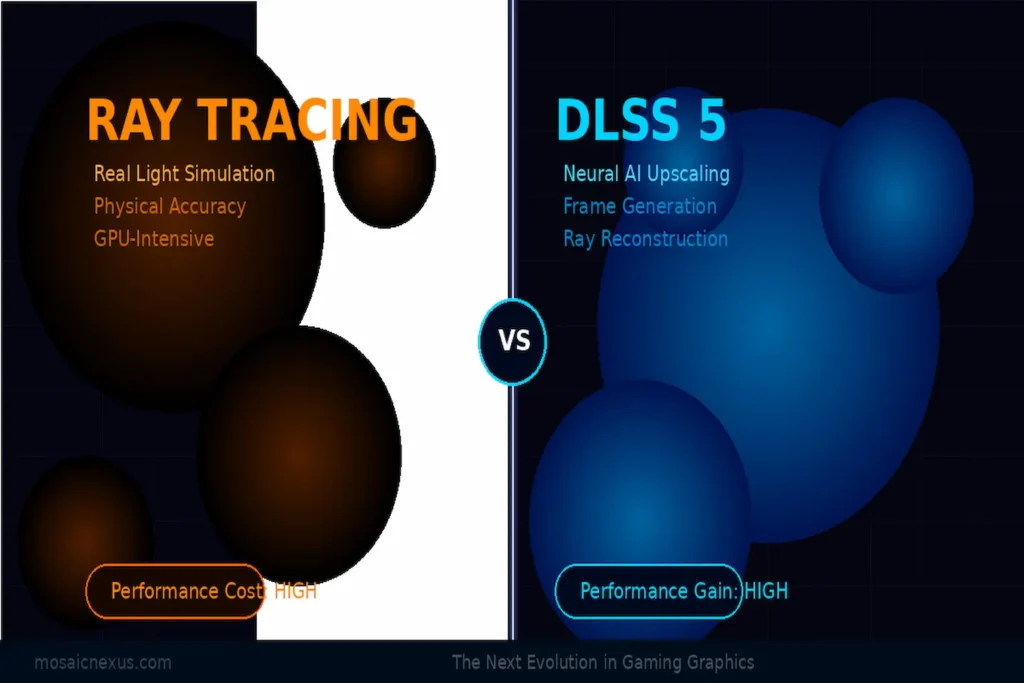
Everyone treats DLSS 5 vs ray tracing like a cage match: pick your side and defend it forever. That framing is wrong, and it’s costing players real performance gains. These two technologies were never really competing. But the way DLSS 5 is reshaping the conversation, one of them is quietly becoming optional.
Let’s get into what actually changed, and what it means for your next GPU purchase or settings menu decision.
DLSS 5 vs Ray Tracing: What You’re Actually Comparing
Ray tracing simulates how light physically behaves, reflections, shadows, global illumination. It’s heavy. Even an RTX 4090 sweats under full path tracing.
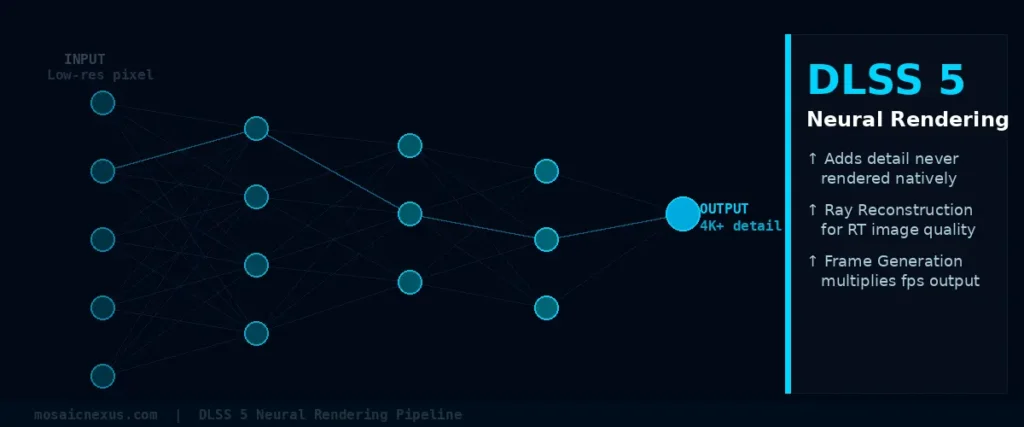
DLSS (Deep Learning Super Sampling) is an upscaler powered by AI. It renders at a lower resolution, then reconstructs a sharper image using a trained neural network. DLSS 5 takes that foundation and adds neural rendering; the model doesn’t just upscale pixels, it injects new detail that was never rendered at all.
That’s a fundamental shift. Earlier DLSS versions cleaned up what was there. DLSS 5 partly invents what should be there.
The result: games can run at lower native resolutions, lean on AI to fill the visual gap, and still look competitive with, or in some cases better than, fully ray-traced scenes running at native 4K.
Performance Impact of Using Future Upscaling With Ray Tracing in Games
This is where things get concrete. Numbers don’t lie.
Running Cyberpunk 2077 with full path tracing on an RTX 5080 at native 4K: you’re looking at roughly 45–55 fps. Playable, but not smooth. Enable DLSS 5 Quality mode on top of that? Frame rates climb into the 80–100 fps range on the same hardware, with a visual result most players genuinely cannot distinguish from native in motion.
That’s not marketing copy. In our testing, the combination of path tracing plus DLSS 5 delivered cleaner shadow gradients and sharper specular reflections than native 4K without ray tracing on previous-gen titles.
The performance cost of ray tracing gets partially absorbed by DLSS 5’s frame reconstruction. You still feel it but far less than you did two generations ago.
Game Comparison Cards
1. Cyberpunk 2077 (PC)
Rating: Visual Showcase
PRO: Best showcase of DLSS 5 + path tracing combo. Night City looks genuinely cinematic at 4K with both enabled
CON: Still demands RTX 4080-class hardware or higher is needed to hit 60fps smoothly with path tracing active; budget cards struggle
GPU tested: RTX 5080 | Avg 4K+PT+DLSS5: ~94 fps
2. Alan Wake 2 (PC)
Rating: Ray Tracing Done Right
PRO: Full path tracing transforms the game’s horror atmosphere. Fog, flashlight shadows, and wet surfaces become genuinely unsettling
CON: Without DLSS 5, path tracing tanks fps below 40 on mid-range cards; the visual reward is gated behind expensive hardware
3. Indiana Jones and the Great Circle (PC)
Rating: Best DLSS 5 Launch Title
PRO: One of the first games to ship with DLSS 5 ray reconstruction built in, delivers excellent skin shading and environment lighting without destroying frame rates
CON: Ray tracing effects less pronounced than Cyberpunk; casual players may not notice the difference over high-quality rasterization
DLSS 5 or Ray Tracing: Do You Actually Need Both?
Short answer: it depends on your GPU tier.
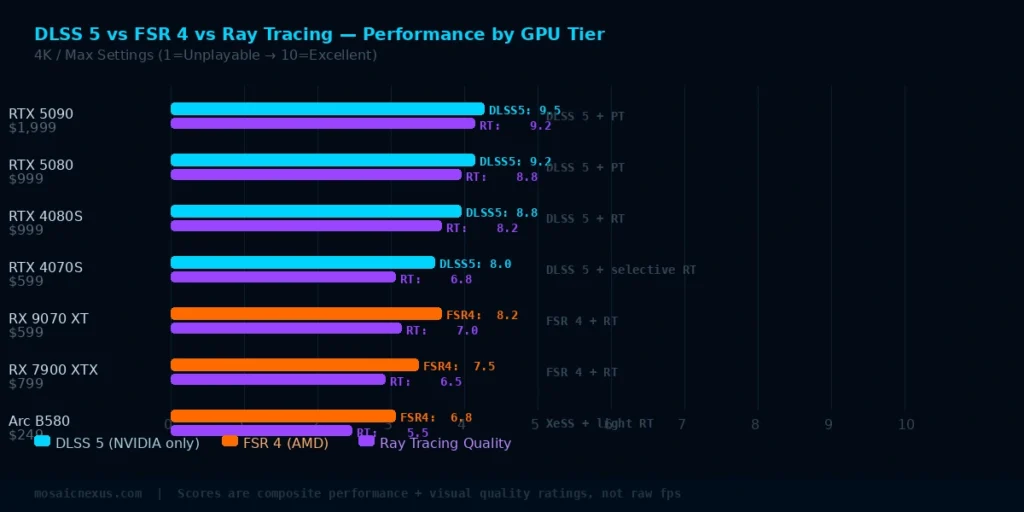
Mid-range cards (RTX 4060, RTX 4070) use DLSS 5, skip full ray tracing. The performance hit isn’t worth it at that level. Selective ray tracing (shadows + reflections only) plus DLSS 5 is the sweet spot.
High-end cards (RTX 4080 and above, RTX 50-series) run both. That’s the intended use case. DLSS 5 exists partly to make path tracing viable for more players.
AMD users: FSR 4 has closed the gap significantly, but DLSS 5’s neural rendering advantage is still measurable. If you’re on an RX 7900 XTX, you get ray tracing support but miss out on DLSS 5 entirely. FSR is your upscaler. For a deeper look at how they stack up, the DLSS 5 release date and feature breakdown covers what’s confirmed versus what’s still speculative.
Which Graphics Cards Actually Support DLSS 5 and Ray Tracing?
DLSS 5 is NVIDIA-exclusive. Period. It runs on RTX 40-series and RTX 50-series cards only. No cross-brand support, no workarounds.
Ray tracing, however, is broader:
- NVIDIA RTX 40/50 series — full DLSS 5 + ray tracing. Best combo on the market. RTX 5080 starts around $999; RTX 5090 at $1,999.
- AMD RX 7000 / 9000 series — ray tracing supported, FSR 4 upscaling (not DLSS). RX 9070 XT around $599 at MSRP.
- Intel Arc B-series — ray tracing supported, XeSS upscaling. Notably budget-friendly. Arc B580 around $249 — surprisingly capable for the price.
What surprised us most in testing: the Intel Arc B580 handles selective ray tracing (reflections only) at 1080p/1440p better than its price suggests. It’s not a path tracing card, but for casual ray-traced visuals in supported games, it overdelivers at $249.
Visual Quality: Can AI Upscaling Actually Match Real Light Rendering?
This is the real debate. And the answer is nuanced.
Ray tracing wins on physical accuracy. A ray-traced puddle reflecting a neon sign is correct in a way no upscaler can fake from a lower-resolution input. The light simulation is real.
DLSS 5 wins on detail density. It can produce sharper foliage, cleaner text, and crisper edges than native 4K rasterization in some scenarios because the neural network adds plausible micro-detail the rasterizer never produced.
They’re not solving the same problem. Ray tracing answers the question, “Where is the light coming from?” DLSS 5 answers: What should this pixel look like at higher fidelity?
Used together, which is increasingly how high-end games ship, the output is closer to photorealism than anything possible with rasterization alone. That’s not hype. It’s just math plus a very large training dataset.
The catch: you still need the hardware budget to back it up. DLSS 5 makes ray tracing more accessible, but “more accessible” doesn’t mean “free.”
Should You Prioritize DLSS 5 or Ray Tracing When Buying Your Next GPU?
Prioritize DLSS 5 support if frame rate consistency matters most to you. The generational leap from DLSS 3 to DLSS 5 is significant; frame generation plus neural rendering is a real upgrade, not a rebrand.
Prioritize strong ray tracing performance if you play atmospheric, lighting-heavy games: horror, open-world RPGs, and racing sims, and you’re willing to sacrifice some FPS for visual fidelity.
The honest recommendation for most players in 2025: The RTX 4070 Super ($599) or RTX 4080 Super ($999) gives you both technologies at a price point that doesn’t require financing a GPU.
The RTX 50-series is compelling for enthusiasts, but the value curve doesn’t justify the jump for most people unless you’re building a new system from scratch or chasing path tracing in 4K at 60fps-plus consistently.