
Picture this: you’re watching a character walk through rain-soaked streets in Resident Evil Requiem. Light from a neon sign catches the wet pavement. It looks like footage from a Sony film production — not a rendered game frame. That’s the demo Nvidia showed at GTC 2026 on March 16, and it’s the clearest preview yet of what the DLSS 5 release date — confirmed for Fall 2026 — is going to change about PC gaming.
But before you start budgeting for an upgrade, let’s slow down and talk about what DLSS 5 actually is, what it isn’t, and whether the demos you’ve seen represent what you’ll actually get on launch day.
What Is the DLSS 5 Release Date — and What’s Actually Shipping?
Nvidia hasn’t pinned down a specific calendar date, but the company’s official position is Fall 2026. That announcement came directly from Jensen Huang’s GTC keynote, where he described the technology as “the GPT moment for graphics.”
Unlike every DLSS version before it, this isn’t an upscaling update. Previous versions — DLSS 3.5, DLSS 4, DLSS 4.5 — were fundamentally performance tools. They took a low-resolution rendered frame and made it look higher-resolution. Fast. Efficient. Good enough that over 750 games use the technology today.
DLSS 5 is doing something structurally different. It uses a real-time neural rendering model that processes color data and motion vectors from each game frame, then injects photorealistic lighting and material responses — subsurface scattering on skin, fabric sheen, the way light diffuses through foliage. The kind of visual detail that previously required pre-rendered cinematic sequences.
Think of it this way: past DLSS versions were a photo editor sharpening a blurry image. DLSS 5 is closer to an AI that understands what the scene should look like and reconstructs it accordingly.
DLSS 5 vs DLSS 4 vs 3.5: A Straight Comparison
Here’s where the generational differences actually matter for a buying decision:
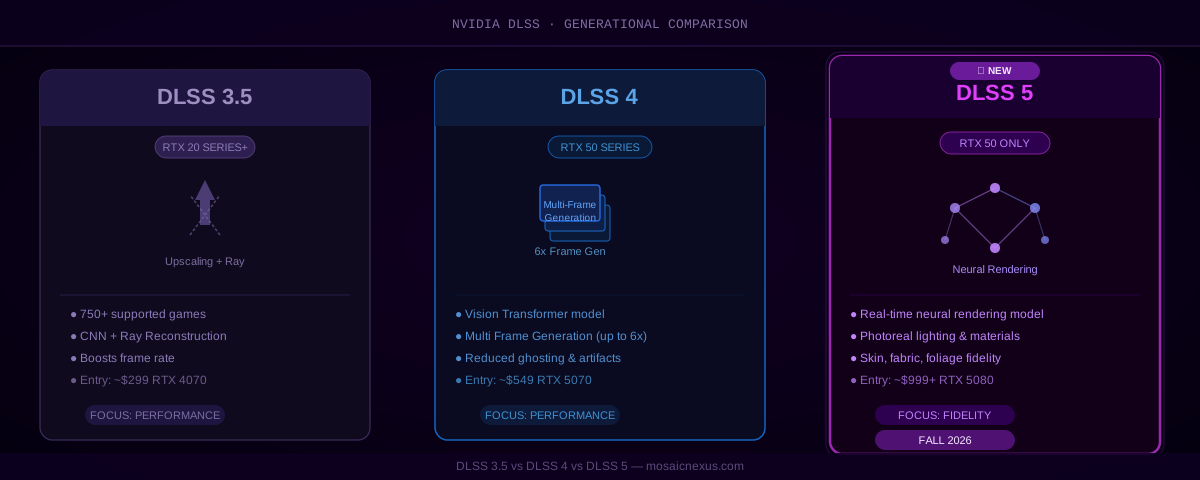
| Feature | DLSS 3.5 | DLSS 4 | DLSS 5 |
|---|---|---|---|
| Primary Goal | Performance + ray tracing quality | Performance + frame generation | Visual fidelity & realism |
| Technology | CNN + Ray Reconstruction | Vision Transformer + Multi Frame Gen | Real-time neural rendering model |
| GPU Requirement | RTX 20 series+ | RTX 50 series (Multi Frame Gen) | RTX 50 series only (at launch) |
| Frame Rate Impact | Positive (boosts fps) | Strongly positive | TBD (performance cost unknown) |
| Lighting Enhancement | Via ray tracing | Via ray tracing | AI-generated photoreal lighting |
| Material Realism | Standard | Standard | Skin, hair, fabric, foliage |
| Game Support (confirmed) | 750+ titles | Growing rapidly | 16 titles at launch |
| US GPU Price Entry Point | ~$299 (RTX 4070) | ~$549 (RTX 5070) | ~$999+ (RTX 5080/5090 likely) |
Pricing reflects approximate US retail as of March 2026. DLSS 5 GPU compatibility beyond RTX 50-series has not been confirmed by Nvidia.
The Myth vs Reality of DLSS 5 Demos
Here’s the part the press releases won’t tell you.
The GTC 2026 demo of DLSS 5 ran on two RTX 5090 GPUs simultaneously. One GPU ran the game. The other did nothing but process DLSS 5 neural rendering. That’s around $4,000 in GPU hardware for a technology Nvidia says will ship on a single GPU later this year.
That’s not a scandal — it’s normal for pre-release research technology to be computationally expensive. Nvidia has three years of development ahead before Fall 2026. But it does mean the stunning visuals you saw on stage may not represent day-one performance on a single RTX 5090.
Myth: “DLSS 5 will make my RTX 5070 look like a Hollywood production.”
Reality: DLSS 5 at launch is almost certainly going to be demanding hardware. Expect the best results on RTX 5080 and 5090. Entry-level RTX 50-series users may see a more modest uplift, similar to how path tracing today is technically available on the RTX 4070 but practical only on the 4090.
Also worth noting: the GTC comparison appeared to pit DLSS 5 against no DLSS at all. A fairer benchmark — DLSS 5 versus DLSS 4.5 with full path tracing enabled — hasn’t been shown publicly yet.
Which Games Are Getting DLSS 5 First?
Nvidia confirmed 16 titles and nine publishers at launch. The confirmed games include:
- Starfield — Bethesda confirmed; Todd Howard specifically called it out during the keynote
- Hogwarts Legacy — already a DLSS showcase; DLSS 5 should significantly upgrade outdoor lighting
- Assassin’s Creed Shadows — Ubisoft is a launch partner; feudal Japan environments will benefit from foliage rendering
- Resident Evil Requiem — used as the primary character-rendering demo at GTC
- The Elder Scrolls IV: Oblivion Remastered
- Phantom Blade Zero, Delta Force, NARAKA: BLADEPOINT, Where Winds Meet
Publishers committed include Bethesda, Capcom, Ubisoft, Warner Bros. Games, Tencent, NetEase, NCSOFT, Hotta Studio, and S-GAME. That’s a serious lineup for a first wave — particularly with Bethesda bringing Starfield support, a game already known for its DLSS integration.
Notably absent from early announcements: EA, Activision, CD Projekt Red, and Take-Two. Expect those to follow as the Fall 2026 launch gets closer.
DLSS 5 and Your GPU: Realistic Upgrade Costs in the US
This is where things get honest.
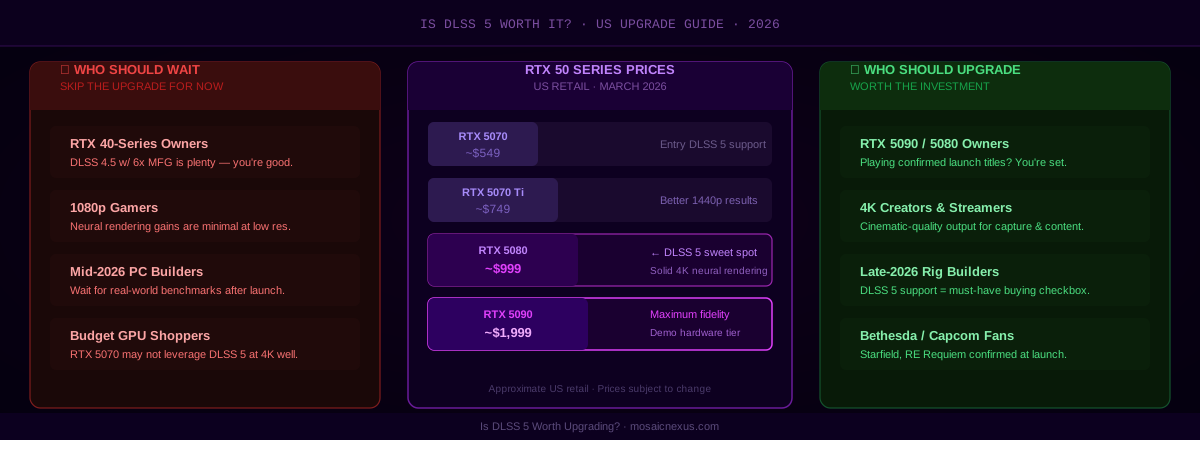
DLSS 5 launches exclusively on RTX 50-series GPUs. Nvidia has not announced support for older architectures. At launch, the GPU tier that will actually make DLSS 5 look good is going to be the RTX 5080 (~$999) or RTX 5090 (~$1,999). The RTX 5070 (~$549) and RTX 5070 Ti (~$749) may support it technically, but real-world results at 4K are likely to be constrained by the computational overhead.
Who should skip DLSS 5 for now:
- Anyone on an RTX 40-series GPU. You’re already getting excellent results from DLSS 4.5, which just dropped in January 2026 with 6x Multi Frame Generation. That’s a major upgrade you haven’t fully explored yet.
- Anyone gaming at 1080p. The neural rendering overhead doesn’t return proportional visual gains at lower resolutions — DLSS 5’s benefits are most visible at 4K.
- Anyone building a gaming PC in mid-2026. Wait for actual Fall 2026 launch benchmarks before committing.
Who should pay attention:
- Content creators and streamers who use their GPU for both gaming and professional work — DLSS 5’s cinematic-quality output has obvious value for capture and streaming quality.
- Owners of an RTX 5090 who are already playing the confirmed launch titles.
- Anyone building a high-end rig for late 2026 — DLSS 5 support should be a checkbox in your GPU decision.
If you’re looking for titles to play while you wait, the latest Xbox Game Pass library includes several games already supporting DLSS 4, which is the most practical high-performance option available right now.
The Bigger Picture: What DLSS 5 Actually Signals
Nvidia’s ambition here extends beyond gaming. The company is explicitly positioning DLSS 5 as a bridge between real-time game rendering and cinematic CGI. Jensen Huang’s claim that this is “the GPT moment for graphics” is bold — but it’s not incoherent.
GPT-4 didn’t just improve text quality. It changed what text generation was fundamentally for. DLSS 5 is attempting something similar: not just better-looking games, but a different category of visual output entirely. Developers at Bethesda and Capcom aren’t just saying “it looks better” — they’re describing it as a tool that removes artistic constraints.
That’s real. But it takes time for a technology to mature from impressive demos to consistent, optimized, affordable experiences. Ray tracing launched in 2018. Eight years later, it’s still not standard across all gaming hardware tiers.
DLSS 5 will matter enormously — eventually. The question is whether “Fall 2026” is the moment it matters for you specifically, or whether you’re waiting for Spring 2027 benchmarks before making a hardware decision.
Frequently Asked Questions About DLSS 5
Nvidia confirmed DLSS 5 will launch in Fall 2026. The announcement was made at GTC 2026 on March 16, 2026. No exact calendar date has been provided yet.
At launch, DLSS 5 is confirmed exclusively for Nvidia RTX 50-series GPUs (Blackwell architecture). Nvidia has not announced support for RTX 40, 30, or 20-series cards. Given the computational demands demonstrated at GTC, optimal performance is expected on RTX 5080 and 5090.
DLSS 3.5 and DLSS 4 are primarily performance technologies — they upscale images and generate extra frames to boost frame rates. DLSS 5 is focused on visual fidelity, not frame rate. It uses a neural rendering model to inject photorealistic lighting and material detail (skin, fabric, foliage) into each game frame in real time, rather than simply sharpening or multiplying frames.
Nvidia confirmed 16 titles at GTC 2026, including Starfield, Hogwarts Legacy, Assassin’s Creed Shadows, Resident Evil Requiem, Oblivion Remastered, Phantom Blade Zero, Delta Force, and NARAKA: BLADEPOINT. Nine publishers are committed, including Bethesda, Capcom, Ubisoft, Warner Bros. Games, and Tencent.
GTA 5 Enhanced supports DLSS 4 including the improved transformer model for upscaling. As of March 2026, Rockstar Games has not been announced as a DLSS 5 launch partner. GTA 5 players can currently enable DLSS 4 through the game’s graphics settings on supported RTX cards — DLSS 5 integration would require a separate future update from Rockstar.
Nvidia integrates DLSS technologies through its Streamline framework, which works with Unreal Engine. While DLSS 4 and its predecessor versions have UE5 plugin support, official DLSS 5 integration for Unreal Engine 5.6 has not been confirmed as of this writing. Expect developer documentation and plugin updates to roll out alongside the Fall 2026 launch window.